Advertisement
Advertisement
July 2024
Sponsored by Agile Devices
Clinical Experience With the Agile Devices Angler® Steerable, Deflectable Microcatheter
A summary of key learnings from the initial 40 limited market evaluation cases.
With Yosef S. Golowa, MD, FSIR; Stephen J. Tully; and Jonathan R. Hinshelwood, MD
Background: Vessel tortuosity poses a challenge during endovascular access and device delivery. Agile Devices Inc., based in Newton, Massachusetts, has developed steerable, deflectable microcatheters designed with unique soft tip deflection and excellent pushability, trackability, and torquing capabilities.
Objective: To report the first-in-human limited market evaluation (LME) cases for the FDA-cleared Agile Devices Angler® 3.0-F, 0.021-inch inner diameter (ID) steerable, deflectable microcatheter. (The Angler® received FDA clearance in January 2022 and is indicated for peripheral and coronary vascular interventions.)
The LME was undertaken to gain marketing and performance data and insights (eg, product performance, ease of use, physician experience, best practices, and optimized in-service training).
Device Description: The Angler® steerable, deflectable microcatheter is a variable-stiffness, single-lumen microcatheter designed to access small tortuous vasculature. The Angler® has a maximum outer diameter (OD) of 0.0394 inches (3.0 F) and an ID of 0.021 inches and has radiopaque marker bands on both ends of the 1.4-cm deflectable tip section to facilitate fluoroscopic visualization of the tip shape. Tip deflection is controlled using a manual steering mechanism that automatically locks the tip shape. The proximal end of the handle incorporates a standard luer.
On-plane 180° bidirectional tip deflection is achieved via coaxial movement of the inner versus the outer shaft, which bends a constrained flat wire on plane inside of the fully covered deflectable distal tip section. The Angler® microcatheter also has a hydrophilic polymer coating over the distal 80 cm, which adds tracking lubricity.
The Angler®’s PTFE lumen is compatible with steerable guidewires up to 0.018 inches and particles up to 500 µm or embolic spheres up to 700 µm, with a rated burst pressure of 1,000 psi (Figure 1).
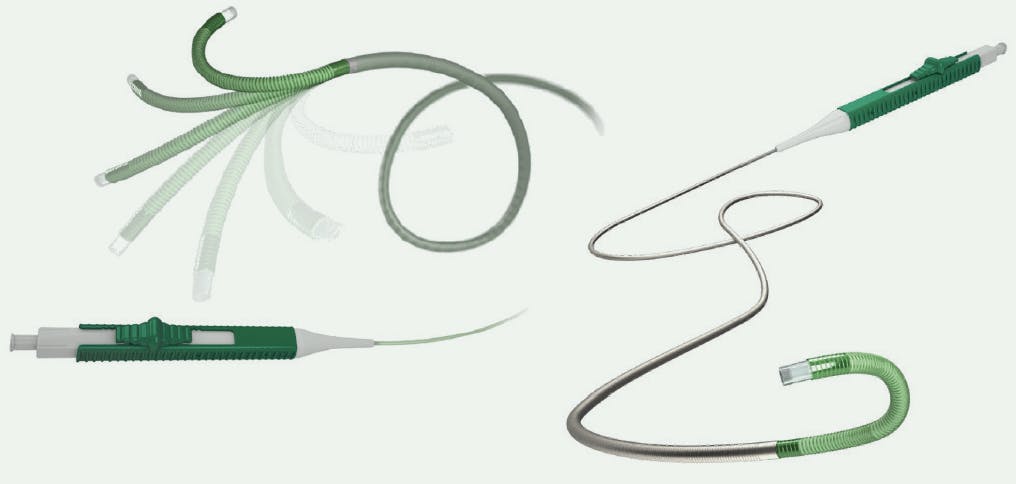
Figure 1. The Angler® microcatheter.
Indications for Use: The Agile Devices Angler® Steerable, Deflectable Microcatheter is intended for general intravascular use, including peripheral and coronary vasculature. Once the subselective region has been accessed, the microcatheter can be used for the controlled infusion of diagnostic agents and delivery of embolic or therapeutic devices. Use only contrast media and therapeutic devices that have been cleared or approved for use in the intended target area.
Per the instructions for use (IFU), here is a list of product indications, contraindications, warnings, precautions, and potential complications and/or adverse events: https://bit.ly/3zufTJl
LME Participants: All LME participants are board-certified practicing interventional radiologists (IRs). Two of the participants are the physician coauthors of this publication (Drs. Golowa and Hinshelwood). Participants had a mean of 14 years of attending experience (range, 3-32 years) and varying experience with other steerable microcatheters.
LOCATIONS AND PROCEDURE TYPES
The Angler® was successfully used in 40 LME cases at nine United States sites, each with a single interventional radiologist (IR) evaluator, between mid-2022 and mid-2023 (see Locations of LME Cases Sidebar). These sites represent a mix of academic medical centers, community hospitals, and office-based labs.
LOCATIONS OF LME CASES
- Massachusetts General Hospital
(Boston, Massachusetts) - Boston Medical Center
(Boston, Massachusetts) - Lowell General Hospital
(Lowell, Massachusetts) - New York-Presbyterian Hospital
(New York, New York) - New York Medicine Doctors
(New York, New York) - University of North Carolina Hospital
(Chapel Hill, North Carolina) - PRISMA Health Greenville Memorial Hospital
(Greenville, South Carolina) - Northwestern Memorial Hospital
(Chicago, Illinois) - Endovascular Consultants of Colorado
(Denver, Colorado)
The Angler® LME was open to all peripheral endovascular procedures from either a transfemoral or transradial approach. In the resultant LME procedures, the Angler® was used to deliver diagnostic agents and embolic or therapeutic devices to a range of targets, including arteries in the liver, prostate, uterus, and gastrointestinal (GI) bleeds.
Various 0.014-, 0.016-, and 0.018-inch wires were used, as well as various 5-F, 0.038-inch compatible base catheters. Additionally, various embolics were delivered, including microspheres, particles, gelfoam slurry, coils, macroaggregated albumin (MAA), and Lipiodol (Guerbet LLC).
METHODS
All IRs attended a 30-minute in-service training conducted by Agile Devices personnel before use. The training included peripheral vascular flow model use and demonstration, along with discussion regarding best practices and any instructions for use (IFU) and/or compatibility questions.
Each LME physician was asked to fill out a feedback form after each case to collect feedback, gain potential future marketing insights, and obtain numeric ratings of performance and user experience (Figure 2).
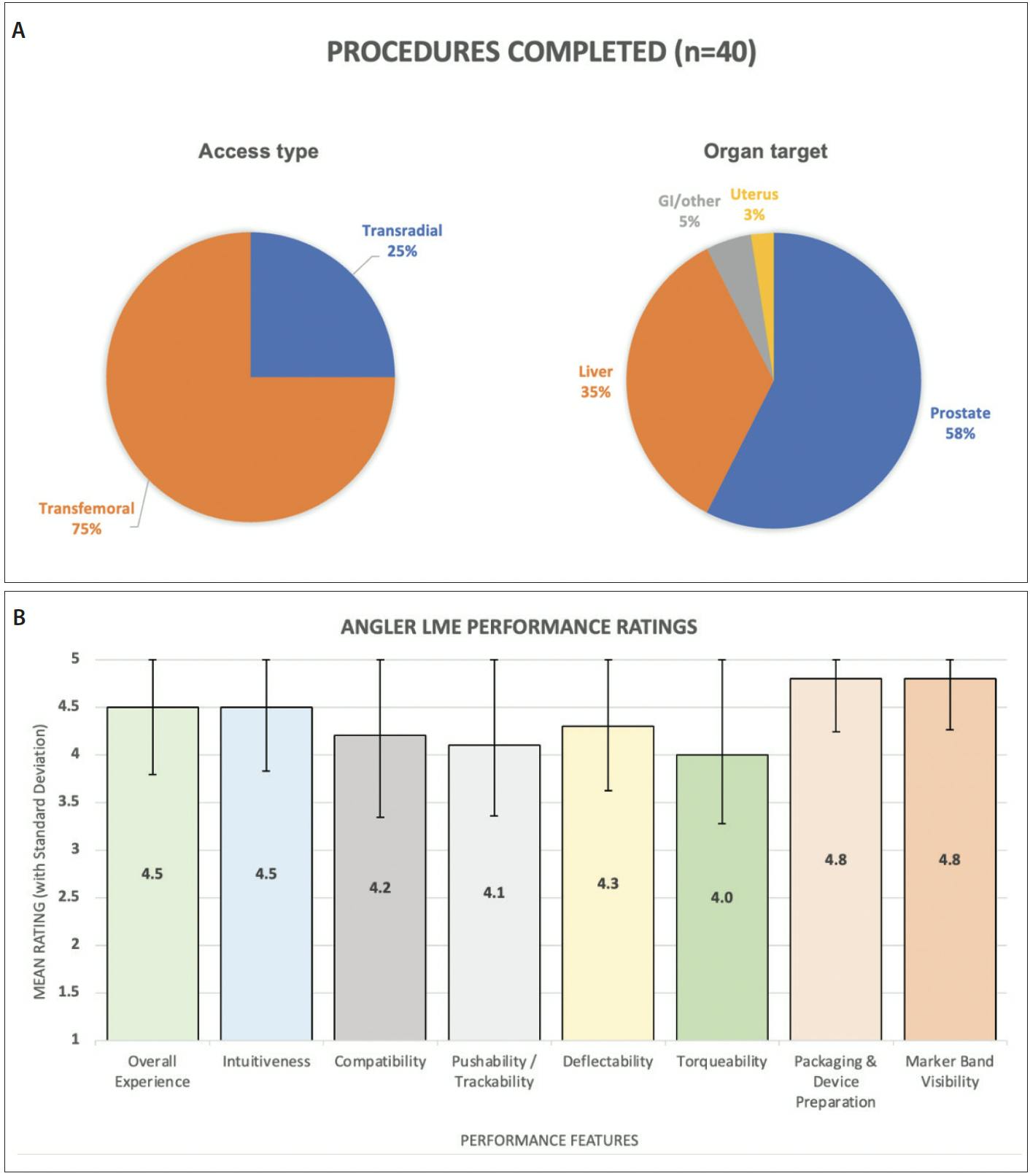
Figure 2. LME procedure mix (A). Average numeric ratings from 40 completed LME forms (1-5 Likert scale; 5 is best) (B). Questions corresponding to the average ratings above can be found at https://bit.ly/4cENkY0.
RESULTS
A total of 40 LME cases were completed. Figure 2 shows the composition of these cases and the average numeric ratings across various evaluation criteria. Figure 3 illustrates selected cases in which the Angler® steerable microcatheter was utilized.
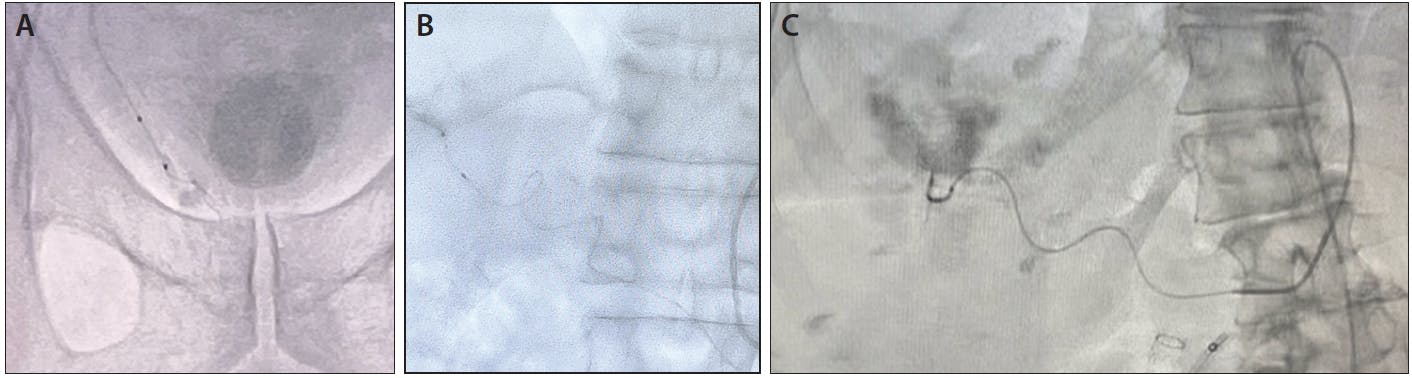
Figure 3. Sample cases in which the Angler® steerable microcatheter was utilized. Prostate artery embolization case in which both right and left pudendal and prostatic feeder arteries were selected and embolized with 100–300-μm Embospheres (Merit Medical, Inc.) and 0.018-inch X 5-mm coils (A). Liver embolization with tortuous anatomy from the right hepatic artery (B). Liver mapping case prior to treatment in which the right and left hepatic and right gastric arteries were catheterized, and MAA and 2-mm Nester coils (Cook Medical) were delivered (C).
Among the 40 completed cases, there were four cases in which the procedure was successfully completed using the Angler® after unsuccessful attempts with other microcatheters. It is important to note that this was not a head-to-head, randomized controlled study and was not intended to evaluate the performance of other microcatheters in comparison to the Angler® (see Limitations).
Seven attempted cases were initially unsuccessful, including five that were in noncompliance with the IFU:
- Two cases in which the physician could not pass through the preferred base diagnostic catheters that had been identified as too small, per the Angler® IFU. Both were completed with smaller outer diameter (OD) conventional microcatheters.
- Three cases in which the device kinked proximally when the Angler® was inserted through the base catheter without a guidewire through it, in contravention of the IFU. All three cases were completed either with another Angler® or with a conventional microcatheter.
- One case in which the Angler® could not track through a small calcified knee vessel (peripheral artery disease). The case was completed with a smaller OD conventional microcatheter.
- One case in which the operator could not deliver a detachable coil. The case was completed with a conventional microcatheter.
There were no device-related reportable safety events.
LIMITATIONS
This LME was a single-arm, retrospective, informal set of case studies. The study was limited to 40 completed procedures, which were not randomized. The results achieved by LME participants may not be predictive of results in future cases.
CONCLUSION
The 40 successful LME cases across nine sites with completed evaluation forms collectively demonstrate that the Angler® steerable microcatheter worked well, providing value to IRs across a wide range of procedure types. IRs who used Angler® reported that the device was intuitive to use and deflected, tracked, and pushed well. All LME participants recommended the use of Angler® following completed cases.
Of note, the Angler® performed well in terms of tracking and pushability in prostate artery embolization cases, despite its larger OD relative to other microcatheters typically used in such cases. The Angler® was shown to deflect and track well to the targets, enabling efficient vessel selection.
There were two primary areas of constructive feedback provided by participants: (1) a request to provide a version of the Angler® with a smaller OD to be compatible with a wider range of base catheters, and (2) a request to make the Angler® handle lighter weight and with a transparent hub. Agile Devices is currently working to incorporate both of these areas of feedback.
Advertisement
Advertisement