Advertisement
Advertisement
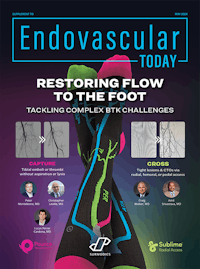
May 2024 Supplement
Sponsored by Surmodics, Inc.
The Utility of the Sublime™ Radial Access Platform for Peripheral Procedures
A conversation with Dr. Craig Walker.
Interventional cardiologist Dr. Craig Walker is the Founder and President of the Cardiovascular Institute of the South, which includes more than 20 clinics in Louisiana, Mississippi, and Illinois. He is also Founder of New Cardiovascular Horizons, a provider of multidisciplinary-accredited conferences to advance the field of cardiovascular care. Dr. Walker is known as a pioneer in interventional cardiology and peripheral vascular interventions and has trained more than 1,500 physicians in advanced peripheral interventional techniques. In this interview, Dr. Walker discusses the current state of the art for the radial-to-peripheral approach and his experience with the Sublime™ Radial Access Platform (Surmodics, Inc.).
You’ve helped to spearhead radial access for treatment of peripheral artery disease. What do you see as the major benefits of this approach?
The radial approach has been used in coronary interventions for years and now is considered an independent predictor of decreased complications, particularly bleeding complications. Bleeding complications can lead to other complications and increased mortality.1 I’ve also found that bleeding complications can reduce patency over time, making it more likely arteries will occlude. But there’s another component that many physicians don’t speak of but is quite important: patient comfort. Patients find radial access far more comfortable than femoral access.2
Pedal access is also used as an alternative to the femoral approach for lower extremity procedures. How would you compare the radial and pedal approaches as alternative access sites?
There are certain anatomic reasons why we would not want to even try a pedal access. Whenever we are putting sheaths in small vessels, there’s a chance that those vessels will occlude over time. When we’re using radial, we’re not using it because the arm is sick, but when we’re doing a pedal approach, we’re doing it because the leg is sick, and attrition of those vessels may be catastrophic in the long run. Radial is a low-bleeding access site.1 Having said that, it has its own risks and challenges. But in patients who have been properly selected—those who have a radial artery of appropriate size and anatomy and have good palmar arch flow—radial access can be very safe with the proper technique. As a practical guide, I’ve written what I consider to be the 13 steps required to avoid radial artery complications in peripheral artery interventions.3
What are some of the other reasons for physicians to use radial access for peripheral procedures?
For treatment of peripheral disease, radial access can provide the ability to treat both legs in a single setting. That’s very difficult to do from femoral access. Radial access allows us to treat and not have to compress an artery that we’ve just treated. When we compress an artery that we’ve just treated, we’re diminishing the blood flow and thereby may be increasing the risk of thrombosis. In addition, we can use radial access even in patients who are completely anticoagulated with much less risk of subsequent bleed.4 I’ve had many such patients—patients I was told could not come off their warfarin for even a second because if they did they would throw emboli from their aortic valves.
There are many reasons to use radial access, but I think what’s going to drive this in the long run is patient comfort. We don’t speak about the fact that, for example, many men simply cannot urinate after we’ve given them contrast when they’re lying on their backs. That’s a really big deal. With radial access, a patient is sitting up in a lounge chair immediately after the procedure. They can watch and change the television channel. The patient feels in control at that moment, and so patients like this approach.
Of course, another driver of adoption for the radial-to-peripheral approach is creation of tools that are getting us to the lesions, allowing us to cross the lesions, and allowing us to treat these lesions. One of the first steps was development of low-profile, low-friction, slippery sheaths. Along with that has come longer wires, longer balloons, longer stent delivery systems, at least one atherectomy device that’s longer, and a long drug-coated balloon. All these things have improved our ability to use the radial approach, albeit we still don’t have a full armamentarium of tools. I suspect that will be coming.
What has been your experience with the Sublime™ portfolio of radial-to-peripheral products?
I have been impressed with the performance of the Sublime™ Guide Sheaths. They have the long lengths we can use. I think these sheaths are certainly on par with the best of the best—a very, very good sheath that’s very easy to place. I like the feel of the sheath. From the outside, I think it works very well, and I’ve found it to go around bends very well. I’ve had a couple cases where a Sublime™ sheath passed when some competitive sheaths did not.
I’ve also been impressed with Sublime™ Radial Access Balloon Catheters. They’re on a very long shaft, which gives me the ability to push further from the shaft. I’ve found these balloon catheters cross lesions very well. Even the longest Sublime™ balloon catheters aimed at infrapopliteal spaces, where I’m working at a great distance in highly obstructed lesions, I’ve found work very effectively.
You’ve recently had experience using Sublime™ Microcatheters for peripheral cases. Can you comment on their performance?
With radial access, when we’re treating the lower extremities from a farther distance, we will have slightly less push, and we have to learn how to mitigate that. So, one of the things that I’ve been very impressed with are the Sublime™ Microcatheters that Surmodics has created.
These catheters help us cross lesions because, first, they’re hydrophilic, they’re very slippery. Second, one can rotate these catheters. Being able to rotate them, or torque them to use another term, allows the catheter to pass through a lesion much more easily. It’s related to the physics of orthogonal displacement of friction, which occurs when we rotate things. So even when we’re into a high frictional element, this device, which is very slippery, has a nice rigid body. In addition to that, the .014 and .018 catheters can fit inside of the .035, so we can create a telescoping system.
In some cases—even cases in which I’m not using these catheters from a radial approach—I’ve been impressed that by simply rotating these catheters in long total occlusions, I can easily cross lesions in very short order. I have a case that I’ve reported on this (page 18). This was a long chronic occlusion, not a patient who had just developed symptoms. The catheter easily crossed this entire lesion in about a minute with very little resistance. I never pushed the catheter, I simply rotated and kept rotating, and the catheter went through.
The fact that these catheters have a braid, can telescope, and have a low coefficient of friction once wet really helps to negate some difficulty in crossing lesions. I also like the concept of using Sublime™ catheters in a telescoping fashion, first placing the smaller catheter in very hard lesions followed by the bigger catheter because, in a sense, what that is doing is predilating the lesion. This may allow me to more easily deliver subsequent therapies that I’m planning to deliver.
In lectures I’ve given around the world, I’ve stressed that a wire always should work in concert with a crossing catheter, because a crossing catheter, if we bring it closer to the end of the wire, gives that wire far greater penetration. It gives us better ability to torque that wire at the end, because we are creating a shaft around the wire that stops the bend within the wire as you’re going down, allowing us to direct the wire better. If we get hung up in a lesion, we can come down and give the wire a little more “umph” in crossing—a little greater push at that point. It also helps to protect the wire against damage.
Finally, using crossing catheters as I’ve described allows us to take a picture after crossing a lesion to better see what is going on beyond the lesion. Often, when there’s a critical lesion or a total occlusion, we take pictures but may only see ghost-filling of vessels. We just don’t see the vessel very well. Using crossing catheters allows us to obtain a very detailed image of what lies beyond, and that detailed image may really help us to better plan step two. When we’re doing these cases, we’re not playing checkers and thinking of just the first move. We have to think of subsequent moves, because our goal is checkmate and restored flow, not just taking one more piece off the board.
Caution: Federal (US) law restricts the Sublime™ Radial Access Guide Sheath, the Sublime™ Radial Access .014 and .018 RX PTA Dilatation Catheters, and the Sublime™ Radial Access .014, .018, and .035 Microcatheters to sale by or on the order of a physician. Please refer to each product’s Instructions for Use for indications, contraindications, warnings, and precautions. SURMODICS, SUBLIME, and SURMODICS and SUBLIME logos are trademarks of Surmodics, Inc. and/or its affiliates. Third-party trademarks are the property of their respective owners.
1. Lawton J, Tamis-Holland J, Bangalore S, et al. 2021 ACC/AHA/SCAI guideline for coronary artery revascularization: a report of the American College of Cardiology/American Heart Association Joint Committee on Clinical Practice Guidelines. J Am Coll Cardiol. 2022;79:e21-e129. doi: 10.1016/j.jacc.2021.09.006
2. Cooper CJ, El-Shiekh RA, Cohen DJ, et al. Effect of transradial access on quality of life and cost of cardiac catheterization: a randomized comparison. Am Heart J. 1999;138:430-436. doi: 10.1016/s0002-8703(99)70143-2
3. Walker C. Thirteen steps to avoid radial artery access complications in peripheral arterial interventions. Vascular Disease Management. May 2022. Accessed April 15, 2024. https://www.hmpgloballearningnetwork.com/site/vdm/clinical-editors-corner/thirteen-steps-avoid-radial-artery-access-complications-peripheral
4. Ziakas AG, Koskinas KC, Gavrilidis S, et al. Radial versus femoral access for orally anticoagulated patients. Catheter Cardiovasc Interv. 2010;76:493-499. doi: 10.1002/ccd.22527

Advertisement
Advertisement