Advertisement
Advertisement
November 2024
Sponsored by Medtronic
Radial Access for SFA Intervention Using the IN.PACT™ 018 Drug-Coated Balloon With the SpiderFX™ Filter Wire

Level 1 (meta-analysis) and level 2 (randomized controlled) studies have demonstrated the long-term safety and efficacy of the IN.PACT™ Admiral™ paclitaxel drug-coated balloon (DCB) (Medtronic) for treatment of femoropopliteal artery disease either standalone or in conjunction with vessel preparation techniques.1-3 The IN.PACT™ 018 DCB is the newest member of the IN.PACT family, built on the same platform as the IN.PACT Admiral DCB but with a low-profile design intended for better deliverability. Currently, the IN.PACT 018 DCB is commercially available in a 200-cm length over-the-wire catheter, in addition to the 130 cm, providing physicians the option to treat via femoral or radial access.
CASE PRESENTATION
A tall and obese man in his mid-70s (height, 6 ft, 3 in [191 cm]; weight, 262 lbs; body mass index, 33 kg/m2) who was a former truck driver and current heavy smoker developed cyanosis and pain in both feet. He was referred from podiatry due to recurrent toe wounds that took > 3 months to heal. Diagnostic angiography using right transradial access (TRA) demonstrated long-segment right superficial femoral artery (SFA) disease with a chronic total occlusion (CTO) extending 5 cm (Figure 1A), with a 95% focal mid stenosis with bridging collaterals in the left SFA (Figure 2A). Two-vessel runoff via the peroneal and posterior tibial arteries was present bilaterally.
Using 7-F left femoral artery access, the right SFA CTO was successfully treated with the HawkOne™ LX directional atherectomy device (Medtronic), followed by a 6- X 40-mm Chocolate™* percutaneous transluminal angioplasty (PTA) balloon catheter (Medtronic) using overlapping inflations, and then a 6- X 250-mm DCB catheter over a 6-mm X 320-cm SpiderFX™ filter wire (Medtronic). The final angiogram showed a fully patent SFA (Figure 1B). Due to patient and family concerns for potential bleeding complications from femoral access, an overnight hospital stay was required, with bed rest extended to 6 hours. The patient was subsequently referred for TRA for staged left SFA intervention.
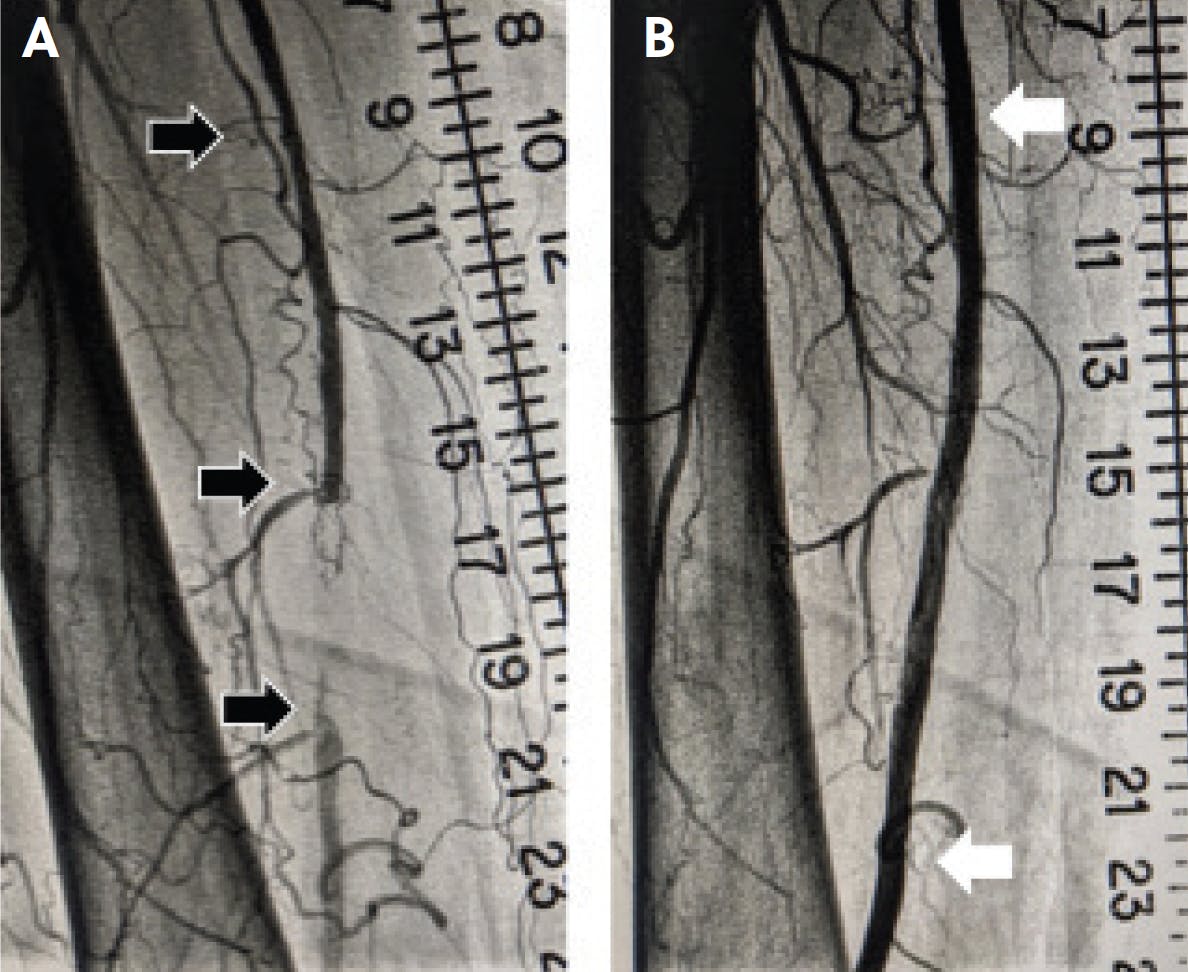
Figure 1. The right long-segment SFA disease, including the CTO, preintervention (A). After treatment with the HawkOne LX device, Chocolate balloon, and DCB over the SpiderFX filter wire via left femoral access (B).
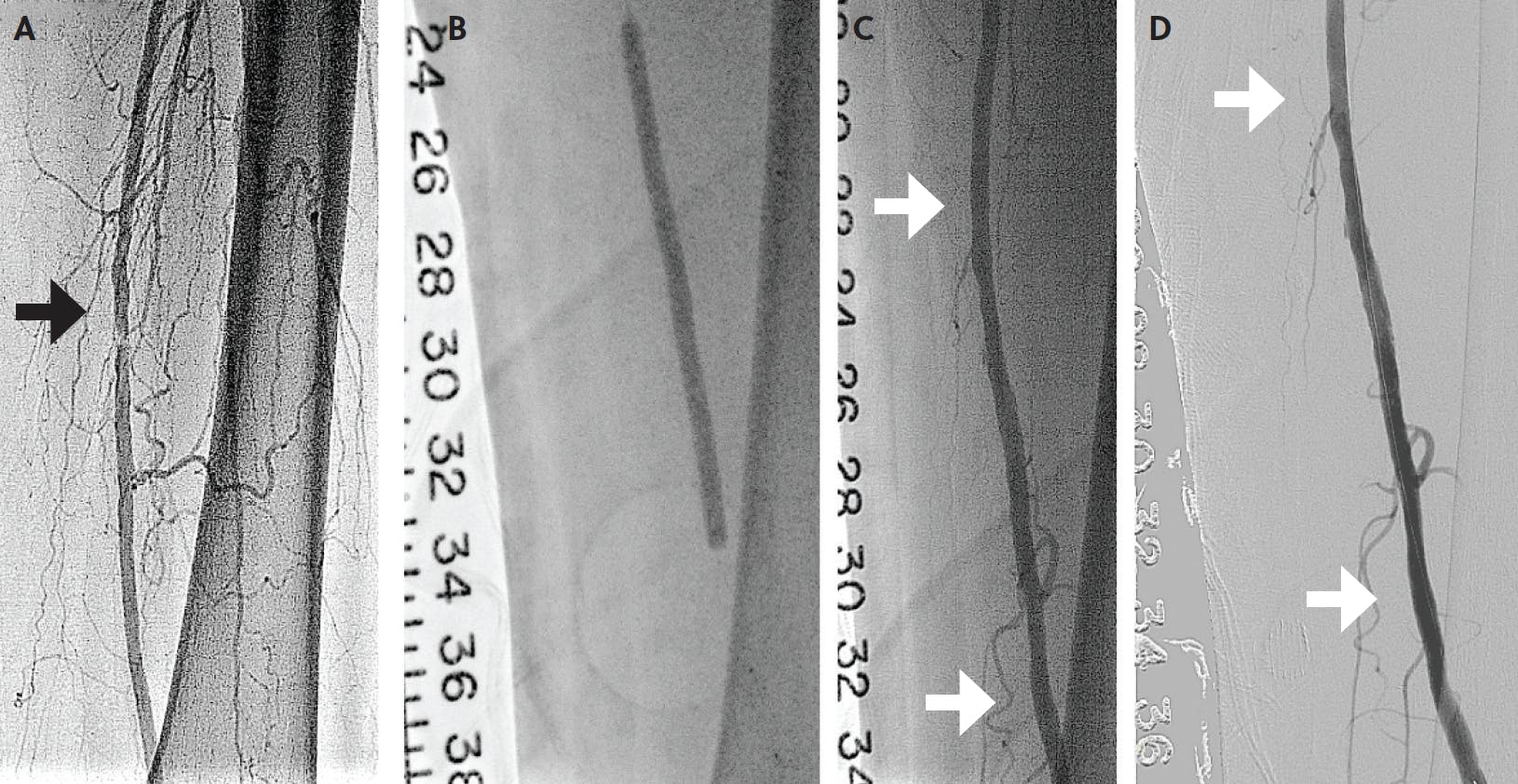
Figure 2. Left SFA with severe focal lesion (A). Left SFA angioplasty with the IN.PACT 018 DCB (B). Left SFA angiogram after treatment with the IN.PACT 018 DCB over the SpiderFX filter wire via left radial access (C). Final digital subtraction angiogram (D).
Ultrasound-guided 5-F left TRA was obtained. A 0.035-inch, 300-cm Wholey™ guidewire (Medtronic) was used to direct a 150-cm, 5-F sheath (Surmodics) into the left iliac artery. The left SFA disease was traversed with a 0.014-inch, 300-cm guidewire, over which a 0.035-inch, 150-cm TrailBlazer™ support catheter (Medtronic) was advanced to the catheter hub in the radial sheath, without reaching the level of the mid SFA, and then removed. A 0.014-inch, 6-mm X 320-cm SpiderFX filter wire was successfully advanced through the guiding sheath and across the SFA in the SpiderFX™ distal protection device delivery catheter, while allowing 1 cm of the distal wire tip to protrude from the catheter tip for lesion crossing; it was then deployed beyond the disease. Predilatation was performed with the 250-cm Sublime™* RX 014 PTA balloon (Surmodics). A 200-cm IN.PACT 018 DCB catheter (Medtronic) measuring 6 X 100 mm was then used to treat the mid-SFA (Figure 2B).
After filter retrieval using the TrailBlazer support catheter, final runoff angiography showed < 20% residual SFA stenosis (Figure 2C and 2D), with no evidence of distal embolization. A TR Band™* (Terumo Interventional Systems) achieved access hemostasis, and the patient was discharged to home 2 hours later. Follow-up at 6 weeks showed complete resolution of the toe wounds, with strongly palpable posterior tibial pulses in both feet.
PROCEDURAL TIPS
The 0.014-inch, 320-cm SpiderFX filter wire is extremely helpful with the described TRA technique for two important reasons. First, it provides distal embolic protection for the procedure. Second, the deployed filter “holds” the wire in a stable position during advancement and exchange of the IN.PACT 018 DCB catheter. I recommend slow initial advancement of the IN.PACT 018 DCB during fluoroscopic visualization of the deployed filter, as this will confirm a stable position of the filter until the back of the filter wire can be secured. After treatment is completed, the DCB balloon catheter is withdrawn over the filter wire until the back of the wire retreats into the proximal hub of the catheter. At this point, a saline-filled 20-mL syringe can be connected to the back of the catheter. Continuous and firm hand injection of saline into the back of the catheter will allow complete withdrawal of the balloon catheter from the guide sheath, while using fluoroscopy to confirm stable position of the filter. Similarly, slow advancement of the 0.035-inch, 150-cm TrailBlazer support catheter until the back of the filter wire is secured also maintains a stable filter position prior to retrieval.
CONCLUSION
The IN.PACT 018 DCB is available in 130- and 200-cm catheter lengths currently, allowing for both femoral and radial access. With the 200-cm length, this 5-F–compatible DCB catheter (up to 6-mm balloon diameter) facilitates endovascular DCB therapy using TRA for SFA/popliteal disease over the 0.014-inch, 320-cm SpiderFX filter wire, including patients taller than 6 feet. Patient populations with typically small radial arteries, including many women, Native Americans, and those of Hispanic or Asian descent, may now be considered for 5-F TRA for treating SFA/popliteal disease using this DCB technology.4
Use of the IN.PACT 018 DCB may likely also prove important when using TRA for SFA/popliteal disease by cost reduction via early ambulation and routine same-day discharge. Medtronic recently entered a distribution agreement to commercialize the first and only 0.018-inch, 400-cm wire in the United States, giving physicians more options when treating via TRA. Future technology needs include the development of longer filter guidewires (> 400-450 cm) and extension of DCB catheter lengths beyond 250 cm.
1. Laird JA, Schneider PA, Jaff MR, et al. Long-term clinical effectiveness of a drug-coated balloon for the treatment of femoropopliteal lesions. Circ Cardiovasc Interv. 2019;12:e007702. doi: 10.1161/CIRCINTERVENTIONS.118.007702
2. Schneider PA, Laird JR, Doros G, et al. Mortality not correlated with paclitaxel exposure: an independent patient-level meta-analysis of a drug-coated balloon. J Am Coll Cardiol. 2019;73:2550-2563. doi: 10.1016/j.jacc.2019.01.013
3. Schneider PA, Brodmann M, Mauri L, et al. Paclitaxel exposure: long-term safety and effectiveness of a drug-coated balloon for claudication in pooled randomized trials. Catheter Cardiovasc Interv. 2020;96:1087-1099. doi: 10.1002/ccd.29152
4. Minor RL Jr. Radial to peripheral in women with small radial arteries: 5 french access for endovascular therapy in femoral, iliac, renal, subclavian and carotid artery disease. Cath Lab Digest. 2023;31.
Disclosures
Dr. Minor: Consultant to Medtronic and Surmodics.
Important Information: Indications, contraindications, warnings and instructions for use can be found in the product labelling supplied with each device.
IN.PACT™ 018 Paclitaxel-coated PTA balloon catheter and IN.PACT ™ Admiral™ Paclitaxel-coated PTA balloon catheter
Indications for Use
The IN.PACT Admiral Paclitaxel-coated PTA balloon catheter and IN.PACT 018 Paclitaxel-coated PTA balloon catheter are indicated for percutaneous transluminal angioplasty, after appropriate vessel preparation, of de novo, restenotic, or in-stent restenotic lesions with lengths up to 360 mm in superficial femoral or popliteal arteries with reference vessel diameters of 4–7 mm.
Contraindications:
The IN.PACT Admiral DCB and IN.PACT 018 DCB are contraindicated for use in:
- Coronary arteries, renal arteries, and supra-aortic/cerebrovascular arteries, patients who cannot receive recommended antiplatelet and/or anticoagulant therapy
- Patients judged to have a lesion that prevents complete inflation of an angioplasty balloon or proper placement of the delivery system
- Patients with known allergies or sensitivities to paclitaxel
- Women who are breastfeeding, pregnant, or are intending to become pregnant or men intending to father children. It is unknown whether paclitaxel will be excreted in human milk and whether there is a potential for adverse reaction in nursing infants from paclitaxel exposure.
Warnings
- A signal for increased risk of late mortality has been identified following the use of paclitaxel-coated balloons and paclitaxel- eluting stents for femoropopliteal arterial disease beginning approximately 2–3 years post-treatment compared with the use of non-drug coated devices. There is uncertainty regarding the magnitude and mechanism for the increased late mortality risk, including the impact of repeat paclitaxel-coated device exposure. Physicians should discuss this late mortality signal and the benefits and risks of available treatment options with their patients.
- Use the product prior to the Use-by Date specified on the package.
- Contents are supplied sterile. Do not use the product if the inner packaging is damaged or opened.
- Do not use air or any gaseous medium to inflate the balloon. Use only the recommended inflation medium (equal parts contrast medium and saline solution).
- Do not move the guidewire during inflation of the IN.PACT Admiral DCB or IN.PACT 018 DCB.
- Do not exceed the rated burst pressure (RBP). The RBP is based on the results of in vitro testing. Use of pressures higher than RBP may result in a ruptured balloon with possible intimal damage and dissection. [IN.PACT Admiral DCB: The RBP is 14 atm (1419 kPa) for all balloons except the 200 and 250 mm balloons. For the 200 and 250 mm balloons the RBP is 11 atm (1115 kPa) – IN.PACT 018 DCB: The RBP is 10 atm (1013 kPa) for all balloons.]
- The safety and effectiveness of using multiple IN.PACT Admiral DCB, or multiple IN.PACT 018 DCB, with a total drug dosage exceeding 34,854 μg of paclitaxel in a patient has not been clinically evaluated.
Precautions
- The safety and effectiveness of the IN.PACT Admiral DCB (0.035 in guidewire compatible), as established in the clinical studies that were performed primarily via femoral access, can be considered supportive for the IN.PACT 018 DCB. Vessel preparation using only pre-dilatation was studied in the IN.PACT Admiral DCB clinical studies. Other methods of vessel preparation, such as atherectomy, have not been studied clinically. The IN.PACT 018 DCB has not been evaluated in a clinical study.
- The IN.PACT Admiral DCB and IN.PACT 018 DCB should only be used by physicians trained in percutaneous transluminal angioplasty (PTA).
- The IN.PACT Admiral DCB and IN.PACT 018 DCB are designed for single patient use only. Do not reuse, reprocess, or resterilize this product. Reuse, reprocessing, or resterilization may compromise the structural integrity of the device and/or create a risk of contamination of the device, which could result in patient injury, illness, or death.
- Assess risks and benefits before treating patients with a history of severe reaction to contrast agents.
- The safety and effectiveness of the IN.PACT Admiral DCB or IN.PACT 018 DCB used in conjunction with other drug-eluting stents or drug-coated balloons in the same procedure or following treatment failure has not been evaluated.
- The extent of the patient’s exposure to the drug coating is directly related to the number of balloons used. Refer to the Instructions for Use (IFU) for details regarding the use of multiple balloons and paclitaxel content.
- The use of the IN.PACT Admiral DCB and IN.PACT 018 DCB carries the risks associated with percutaneous transluminal angioplasty, including thrombosis, vascular complications, and/or bleeding events.
- The IN.PACT Admiral DCB and IN.PACT 018 DCB are not intended for the expansion or delivery of a stent.
Potential Adverse Effects
The potential adverse effects (e.g., complications) associated with the use of the device are: abrupt vessel closure; access site pain; allergic reaction to contrast medium, antiplatelet therapy, or catheter system components (materials, drugs, and excipients); amputation/loss of limb; arrhythmias; arterial aneurysm; arterial thrombosis; arteriovenous (AV) fistula; death; dissection; embolization; fever; hematoma; hemorrhage; hypotension/hypertension; inflammation; ischemia or infarction of tissue/ organ; local infection at access site; local or distal embolic events; perforation or rupture of the artery; pseudoaneurysm; renal insufficiency or failure; restenosis of the dilated artery; sepsis or systemic infection; shock; stroke; systemic embolization; vessel spasms or recoil; vessel trauma which requires surgical repair.
Potential complications of peripheral balloon catheterization include, but are not limited to: balloon rupture; detachment of a component of the balloon and/or catheter system; failure of the balloon to perform as intended; failure to cross the lesion. Although systemic effects are not anticipated, potential adverse events that may be unique to the paclitaxel drug coating include, but are not limited to: allergic/immunologic reaction; alopecia; anemia; gastrointestinal symptoms; hematologic dyscrasia (including leucopenia, neutropenia, thrombocytopenia); hepatic enzyme changes; histologic changes in vessel wall, including inflammation, cellular damage, or necrosis; myalgia/arthralgia; myelosuppression; peripheral neuropathy. Refer to the Physician’s Desk Reference for more information on the potential adverse effects observed with paclitaxel. There may be other potential adverse effects that are unforeseen at this time. Please reference appropriate product Instructions for Use for a detailed list of indications, warnings, precautions, and potential adverse effects. This content is available electronically at manuals.medtronic.com.
CAUTION: Federal (USA) law restricts this device to sale by or on the order of a physician.
Chocolate™* PTA balloon catheter
Indications for Use: The Chocolate™* PTA Balloon Catheter is intended for balloon dilatation of lesions in the peripheral vasculature, including the iliac, femoral, ilio-femoral, popliteal, and infra-popliteal arteries.
Contraindications: Do not use Chocolate PTA Balloon Catheter in the coronary and cerebral vasculature or when the lesion is unable to be crossed with a guidewire.
Potential Adverse Effects of the Device on Health: The potential adverse effects that may occur or require intervention with the use of this device include, but are not limited to, abrupt or subacute closure, allergic reaction to device materials or procedure medications, amputation/loss of limb, aneurysm, anaphylactic shock, arrhythmia, arterial injury (such as dissection, perforation, or rupture), arteriovenous fistula, bleeding requiring transfusion, bypass surgery, death, embolism, endocarditis, fever, hematoma, hemorrhage, hypertension or hypotension, infection, inflammation, intraluminal thrombosis, myocardial infarction, pseudoaneurysm, regional ischemia, renal insufficiency or failure due to contrast medium, sepsis, stenosis or restenosis, stroke, transient ischemic attack, vessel spasm, and vessel trauma which requires surgical intervention.
Caution: Federal (USA) law restricts this product for sale by or on the order of a physician
SpiderFX™ embolic protection device
Indications for Use:
Lower Extremity (LE) Interventions
The SpiderFX™ embolic protection device is indicated for use as a guidewire and embolic protection system to contain and remove embolic material in conjunction with the TurboHawk™ Peripheral Plaque Excision System, either during standalone procedures or together with PTA and/or stenting, in the treatment of severely calcified lesions in arteries of the lower extremities. The vessel diameter at the filter basket placement site should be between 3.0 mm and 6.0 mm.
Potential Complications/Adverse Events: complications associated with the use of the SpiderFX Embolic Protection Device may include, but are not limited to:
Lower Extremity (LE) Interventions: Access site adverse event (e.g., av fistula, hematoma, hemorrhage, pseudoaneurysm, puncture site infection), Adjunct device entanglement, Adverse reaction to antiplatelet/anticoagulation agents or contrast media, Allergic reaction to device materials, Amputation, Aneurysm, Arterial dissection, Death, Device(s) deformation, collapse, fracture, or rupture, Device(s) thrombosis (acute and subacute), Dissection, Embolization of air, debris, plaque or thrombus (evidenced by slow or no-flow) from mechanical disruption by the intervention, Embolization or migration of the interventional device(s), Emergency surgery, GI bleeding due to anticoagulation, Hemodynamic compromise (e.g., prolonged hypotension requiring treatment with intravenous medications), Hypotension or hypertension, Infection, Ischemia, Myocardial infarction, Renal insufficiency, Renal failure requiring dialysis, Repeat intervention to treatment site, Sepsis, Significant cardiac arrhythmia requiring treatment with medications and/or transvenous pacing, Stent entanglement, Stroke, Thrombosis (acute and subacute), Transient Ischemia Attack (TIA), Vasospasm, Vessel dissection, perforation, rupture or intimal flap, Vessel/filter occlusion.
CAUTION: Federal (USA) law restricts this product for sale by or on the order of a physician.
HawkOne™ directional atherectomy system
Indications for Use: The HawkOne directional atherectomy system is intended for use in atherectomy of the peripheral vasculature. The HawkOne catheter is indicated for use in conjunction with the SpiderFX™ embolic protection device in the treatment of severely calcified lesions. The HawkOne catheter is NOT intended for use in the coronary, carotid, iliac or renal vasculature.
Contraindications: Do not use HawkOne in the coronary arteries, carotid artery, or in the iliac, or renal vasculature. Do not use for in-stent restenosis at the peripheral vascular site.
Potential Adverse Effects of the Device on Health: The potential complications include, but are not limited to, amputation, aneurysm, arterial dissection, arterial perforation, arterial rupture, arterial spasm, arteriovenous fistula, bleeding complications, death, embolism or thrombus, arterial bypass surgery, entry site complications, hypotension, infection, ischemia, restenosis of the treated segment, total occlusion of the peripheral artery, vascular complications that could require surgical repair.
CAUTION: Federal (USA) law restricts this product for sale by or on the order of a physician.
Wholey™* guidewire
Indications for Use: The Wholey guidewire system is intended to facilitate the placement and exchange of interventional devices during diagnostic or therapeutic interventional procedures. The guidewire can be torqued to facilitate navigation through tortuous arteries and/or avoid unwanted side branches.
Contraindications: The Wholey guidewire system is not intended for use in the cerebral vasculature or the coronary vasculature.
Potential Adverse Effects of the Device on Health: The potential adverse events associated with guidewires include, but are not limited to: Additional surgical intervention, death, embolization, irritation to a vessel causing a vessel spasm, infection, sepsis, stroke, thrombus development, vessel damage, and vessel perforation.
CAUTION: Federal (USA) law restricts this product for sale by or on the order of a physician.
TrailBlazer™ support catheter
Indications for Use: TrailBlazer support catheters are percutaneous, single lumen catheters designed for use in the peripheral vascular system. TrailBlazer support catheters are intended to guide and support a guide wire during access of the vasculature, allow for wire exchanges and provide a conduit for the delivery of saline solutions or diagnostic contrast agents.
Contraindications: There are no known contraindications.
Potential Adverse Effects of the Device on Health: The potential complications include but are not limited to the following: access site complications, arterial dissection, arterial spasms, arterial thrombosis, catheter fracture with tip separation and distal embolization, death, distal embolization (air, blood clots, or plaque), intimal disruption, local or systemic infection including sepsis, perforation and vessel rupture, and surgical intervention.
CAUTION: Federal (USA) law restricts these devices to sale by or on the order of a physician.
501591 ©2024 Medtronic. Medtronic, Medtronic logo are trademarks of Medtronic. TM* third party brands are trademarks of their respective owner. All other brands are trademarks of Medtronic. For distribution in USA only. 11/2024
Advertisement
Advertisement