Advertisement
Advertisement
April 2025
Sponsored by Terumo Interventional Systems
Completing the Loop With R2P NaviCross
A case example highlights the role of the R2P® NaviCross® support catheter in filling some of the last remaining technology gaps in radial access for endovascular procedures.
Having been involved in transradial endovascular intervention from its early days, I have seen a rapid rise in product development to address procedural shortcomings from this access site. Terumo Interventional Systems has been a leader in this transradial revolution and has brought to market a remarkable transit catheter designed for crossing complex lesions with success from the transradial approach.
Available options were—until now—very limited with regard to crossing long-segment complex lesions and/or chronic total occlusions from the radial approach. The previous generation of catheters were flimsy, had poor torque response, and carried issues regarding length. To complete procedures, advanced techniques such as retrograde access would often be necessary, making these cases longer and more cumbersome.
The R2P® NaviCross® support catheter (Terumo Interventional Systems) addresses these issues in an ideal manner. It is 200 cm in length, allowing it to facilitate crossing long-length lesions, and can reach the popliteal artery in patients of all heights. The double-braided, stainless steel design not only provides the ability to push through the toughest of lesions but also maintains a remarkable one-to-one torque response. The 40 cm of hydrophilic coating on the tip allows for crossing extremely tight lesions. The three radiopaque markers are useful for identifying the catheter tip as well as measuring lesion length; they are 100 mm apart, with a dividing marker 40 mm from the most proximal tip. With both angled and straight tip catheters, various lesion morphologies can be tackled.
The case described in this article provides a prime example of the utility of this catheter when treating complex lesions from the radial approach.
CASE EXAMPLE
A man in his mid-60s presented with limiting left calf claudication affecting his ability to complete one block of walking for the past year. He did not report rest pain or poorly healing lower extremity wounds, and attempts to walk through the claudication were unsuccessful. He was compliant with clopidogrel and cilostazol therapy.
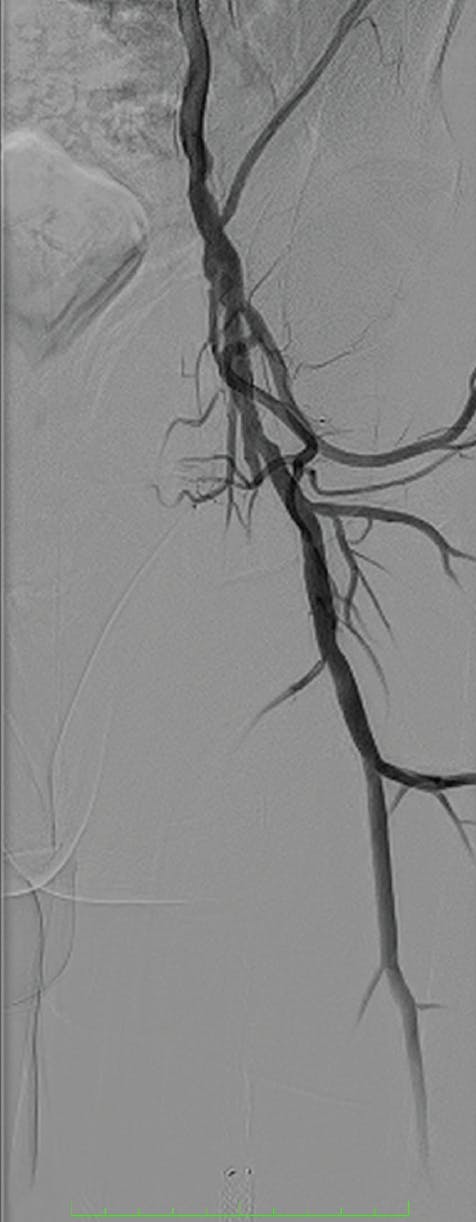
Pretreatment angiogram of the SFA occlusion.
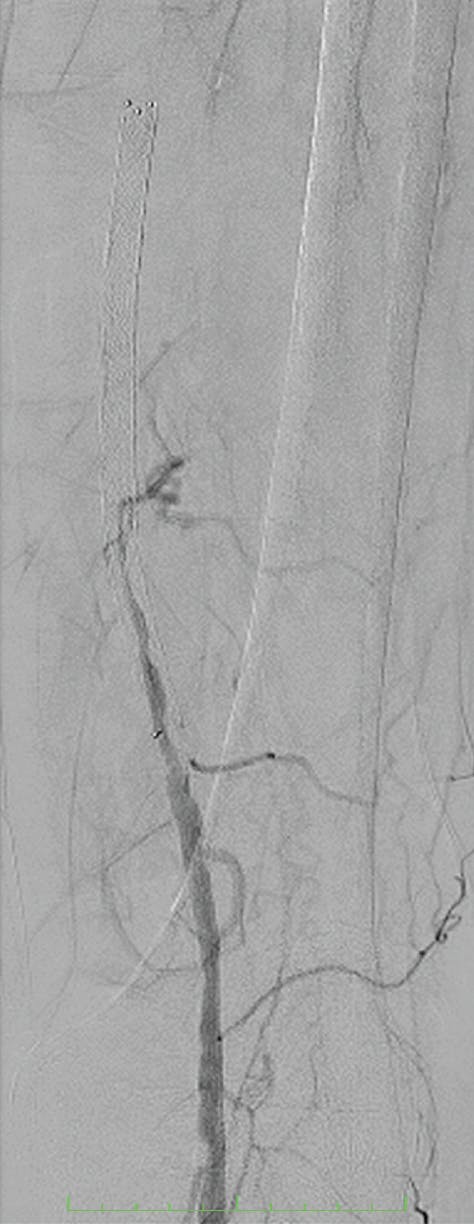
SFA in-stent restenosis.
The patient’s past medical history included two-vessel coronary artery bypass grafting 2 years prior for coronary artery disease, bilateral superficial femoral artery (SFA) interventions approximately 7 years prior for peripheral artery disease, carotid endarterectomy for carotid artery stenosis, and previous heavy tobacco use.
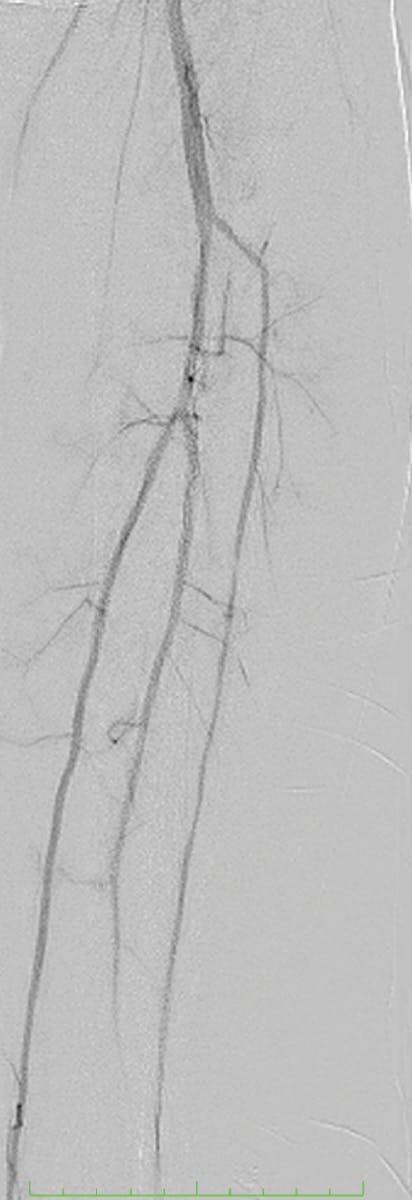
Angiogram of the distal tibial vessels.
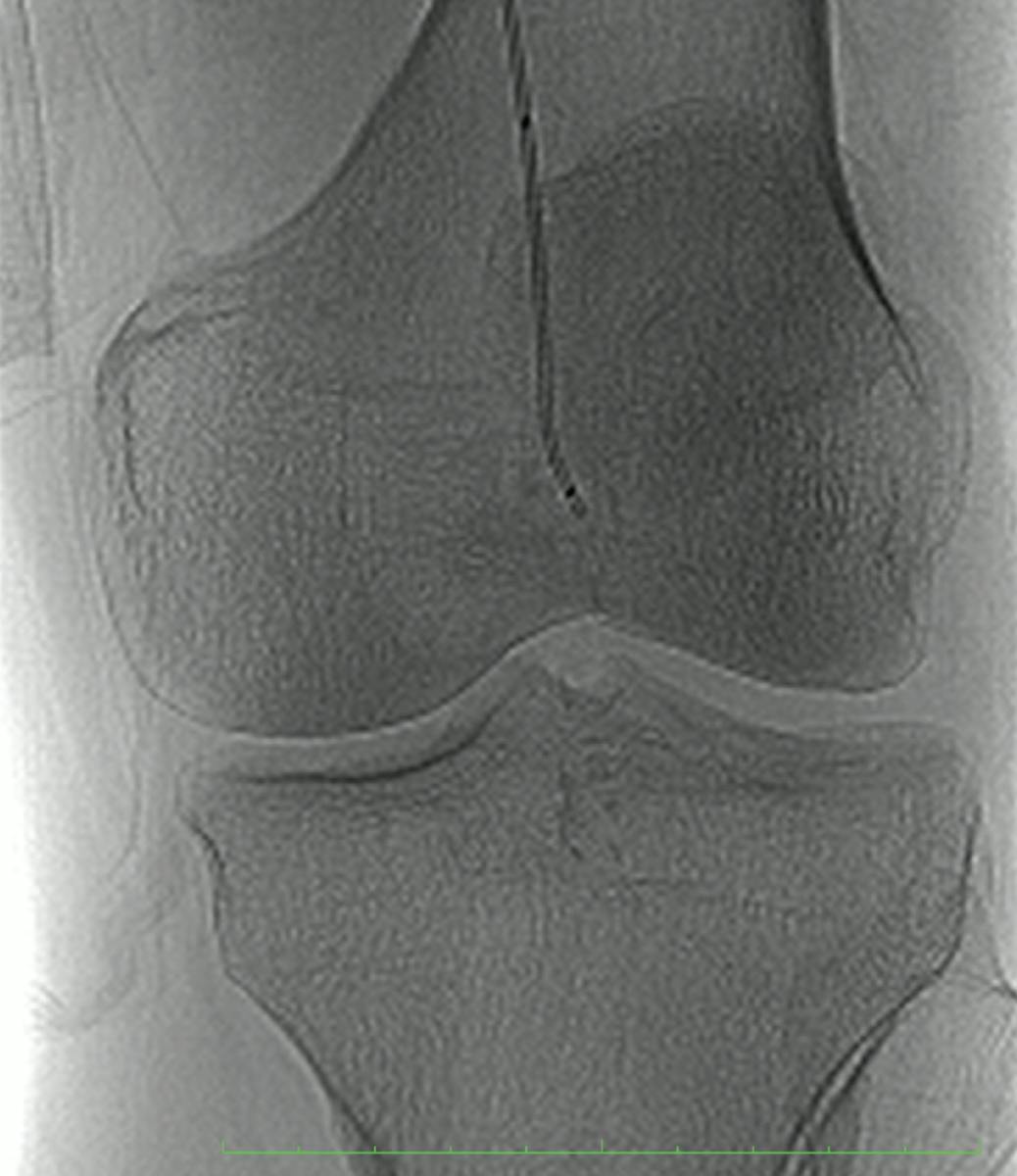
R2P NaviCross crossing the popliteal artery.
A lower extremity arterial ultrasound was performed and demonstrated long-segment left SFA total occlusion with three-vessel runoff.
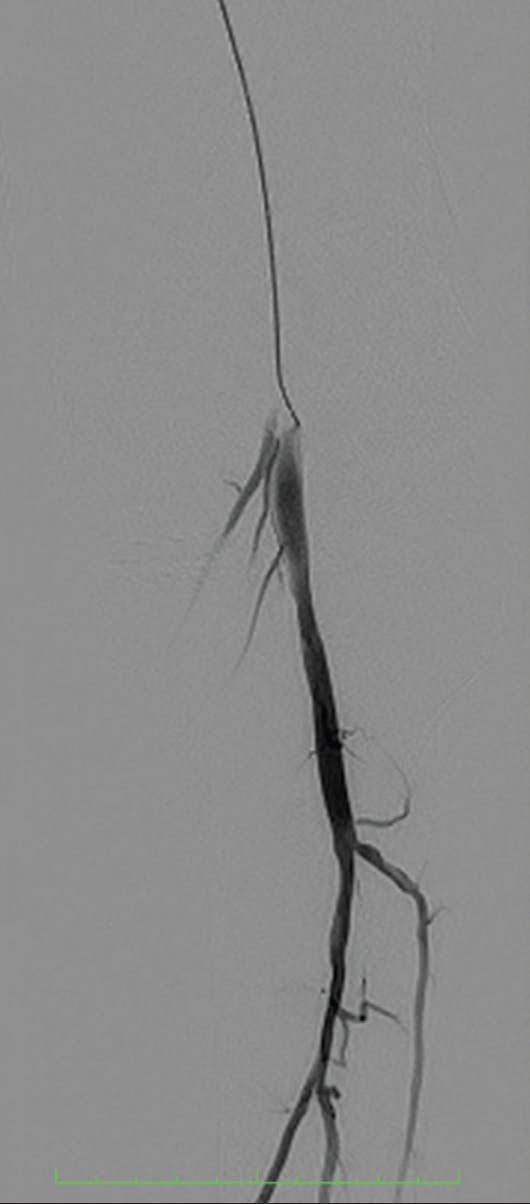
Pretreatment R2P NaviCross deployed in the popliteal tibioperoneal trunk and tibial vessels.
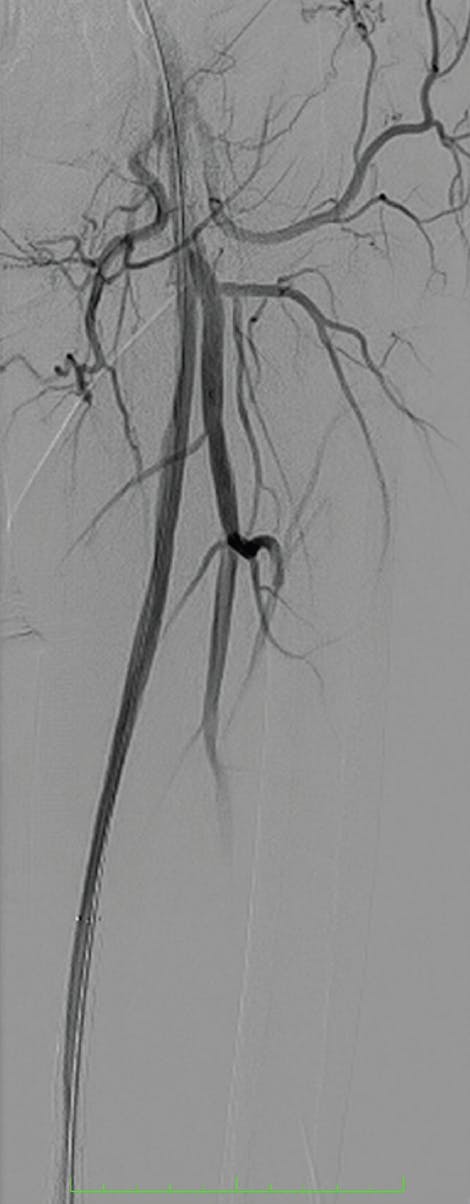
Pretreatment angiography catheter transit.
Given the patient’s refractory lifestyle-limiting claudication, the decision was made to proceed with endovascular intervention via the right radial approach. A 119-cm R2P Destination® Slender® guiding sheath (Terumo Interventional Systems) was advanced into the left common femoral artery. Using a standard stiff angled Glidewire (Terumo Interventional Systems) and an angled R2P NaviCross catheter, the total occlusion was successfully crossed within seconds, with true luminal placement confirmed via injection through the NaviCross catheter. A radial-length ViperWire (Abbott) was advanced into the distal peroneal artery, and the NaviCross catheter was withdrawn. Laser atherectomy was performed with a 1.5-mm Auryon device (AngioDynamics, Inc.) at 60 mJ/mm2 throughout the length of the lesion, followed by prolonged noncompliant balloon angioplasty with a 6-mm Jade balloon (Abbott [manufactured by OrbusNeich]).
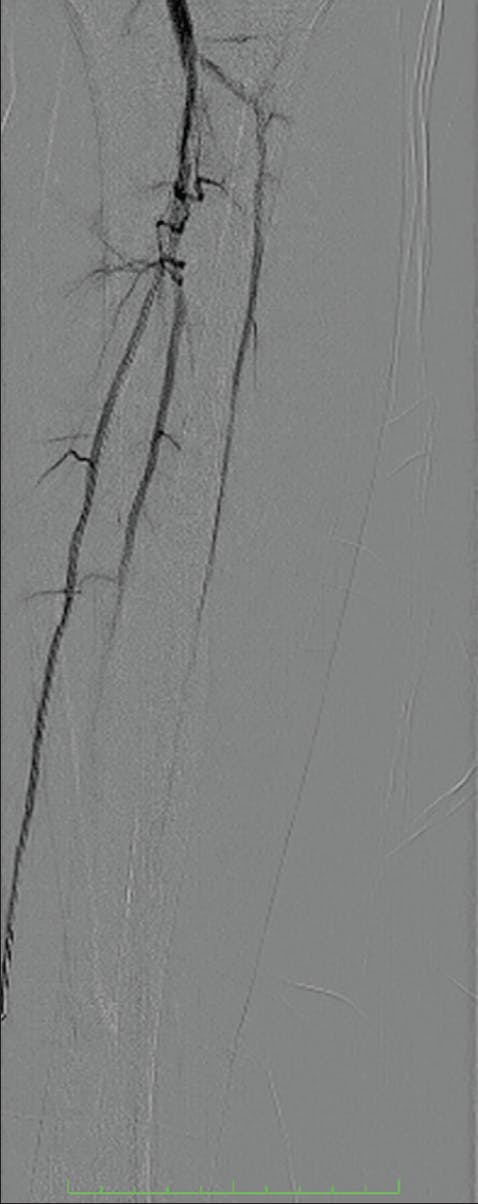
Tibial pretreatment angiogram.
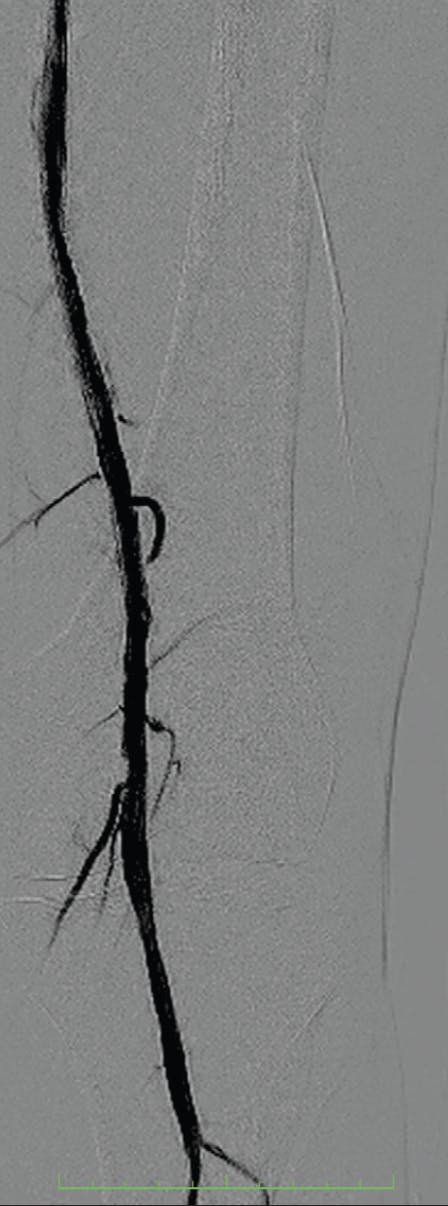
SFA post-treatment angiogram.
Excellent procedural results were noted, with no significant residual stenosis and patent three-vessel runoff to the foot. The total procedure time was 61 minutes.
DISCUSSION
This case highlights the importance of having the right tool for the job. This lesion was predictably difficult to treat given its long length and calcification, as well as the need to cross an occluded stent. The R2P NaviCross catheter facilitated making this case successful by allowing the operator to stay true luminal and cross an expectedly difficult lesion with ease. With this crossing tool specifically designed for cases performed via the radial approach, we have now begun to close the loop of missing technology for radial access endovascular procedures.

Advertisement
Advertisement