Advertisement
Advertisement
April 2025
Vascular Access Care in an Era of Increasingly Scarce Providers and Increasingly Complicated Patients
A case involving chronic venous occlusion in a patient with a recently constructed AV loop graft sheds light on the challenges with today’s dialysis access landscape.
By Kevin Onofrey, MD, and Xhorlina Marko, MD
Hemodialysis (HD) is a life-sustaining treatment for individuals with end-stage renal disease. Globally, > 2 million people are undergoing dialysis or have received a kidney transplant to manage kidney failure. However, this figure may represent only 10% of those who need treatment to survive.1 As of September 2024, approximately 518,970 patients were receiving dialysis treatment in the United States alone.2 That number is only expected to increase in the future as the prevalence of chronic kidney disease (CKD) continues to rise worldwide, with the number of affected patients growing at a rate of 5% to 7% per year.3
The prevalence of CKD is rising due to several key factors, including increasing rates of diabetes and hypertension, an aging population, improved survival rates for chronic diseases, environmental and socioeconomic factors, and the expanding use of nephrotoxic medications.
The anatomic options for HD access include arteriovenous fistula (AVF), arteriovenous graft (AVG), and central venous catheter (CVC), and the type of vascular access used for HD significantly influences patient outcomes and life expectancy. Studies have consistently shown that patients receiving HD with a CVC face higher mortality rate compared to those using an AVF. Unfortunately, even with this information, a considerable number of patients receive HD using a CVC in the United States. Data from the United States Renal Data System indicate that in 2021, approximately 85.4% of individuals began HD with a CVC, either alone or with a maturing permanent access.4 Even more concerning, this represents a 4.6% increase from 2018.
More people are receiving and maintaining HD with a CVC for several reasons: rapid progression of CKD, high rates of unplanned or urgent-start dialysis, surgical and vascular access challenges, patient preference and perception, and resource limitations.
These resource limitations are increasingly evident. In our region, access providers are increasingly scarce, with inconsistent availability. There has been an overall reduction in access provider numbers due to retirement and declining reimbursements for needed services.
These factors contribute to patients frequently seeking treatment from a variety of providers and health care systems. These same patients are on HD for varying lengths of time and have undergone multiple procedures to place and maintain AVFs, AVGs, and/or CVCs.
Our initial evaluation of patients presenting for access consideration includes thorough history and physical examinations, highlighting any iatrogenic or physiologic alteration of their AV anatomy; collecting and reviewing previous medical, operative, or procedural documentation; and supplementing the physical exam with noninvasive physiologic and vascular imaging of the limb(s) of interest.
If the investigation reveals concerning subjective or objective findings beyond this initial workup, additional testing modalities such as CT arteriography/CT venography (CTV) and/or conventional angiography/venography are obtained to promote creation of a sustainable, usable, and durable access.
CASE PRESENTATION
A female patient in her early 40s presented with an edematous arm and a recently constructed right upper arm AV loop graft. Her medical history included stage 5 CKD, diabetes mellitus, vitamin D deficiency, hyperlipidemia, hypertension, and mild pulmonary hypertension.
Beyond the loop graft, her procedural history included a radiocephalic fistula in the right arm performed at an out-of-state hospital in the early 2000s that had since thrombosed and a combined kidney and pancreas transplant in 2012 that had since failed. She was undergoing HD via a left internal jugular vein (IJV) tunneled CVC and awaiting clearance for graft access.
Upon examination, the right upper extremity had mild-to-moderate swelling compared to the left. There were healed incisions from the right upper arm loop graft that was completed 1 month prior. The graft had a palpable prominent pulse but no thrill. Bilateral radial and ulnar pulses were symmetric and easily palpable. The previous radiocephalic fistula was thrombosed.
Review of a recent chest radiograph showed a left IJV CVC and a stent in the right axillary region (Figure 1). Upon further questioning, the patient vaguely recalled a stent being placed in her right arm > 10 years prior.
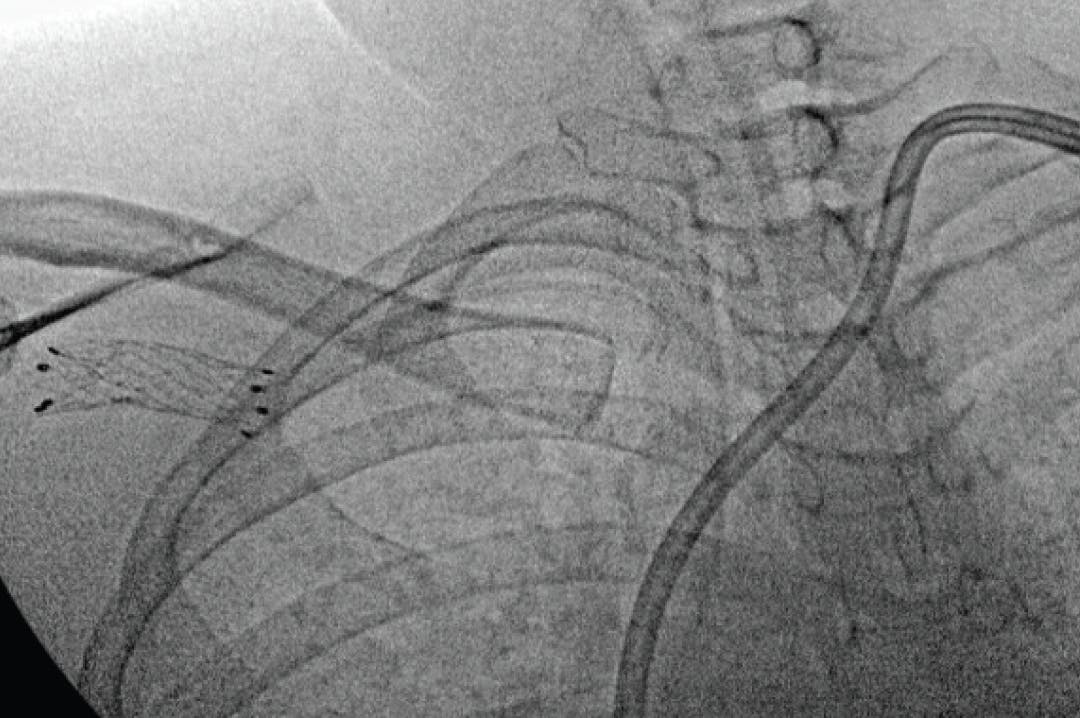
Figure 1. Chest radiograph completed after previous left IJV CVC placement demonstrated a stent in the right axillary region.
Highlight Point
If a patient has had prior CVCs, it is very important to obtain a CTV of the chest prior to creating a dialysis access (AVF or AVG) to assess for any central venous stenosis/central venous occlusion (CVO) that could jeopardize the access patency or maturation. If there is a CVO, recanalization of the occluded segment can be facilitated by an arm and groin access approach (“body floss technique”). Blunt or sharp recanalization techniques can be utilized to cross the occlusion.
CASE CONTINUED
Given the presence of right arm swelling, significantly reduced AVG flow volumes by duplex ultrasound, and evidence of a venous stent, a CTV was obtained. This study revealed chronic occlusion of the right axillary and distal subclavian vein with reconstitution of the central subclavian vein and patency of the superior vena cava (SVC). Numerous right neck and chest wall collateral veins were noted.
Within our interventional suite, the right loop graft was accessed in an antegrade fashion (toward the venous anastomosis), followed by placement of a 6-F sheath. On angiography, it appeared that the previously placed stent was in the cephalic arch and jailing the axillary vein, which ultimately resulted in occlusion of both the axillary and distal subclavian veins. To treat the occlusion, percutaneous access was achieved through the right common femoral vein, followed by placement of a 10-F sheath. Wire access of the SVC and subsequently into the right brachiocephalic vein was achieved, followed by placement of a long 8-F sheath for stability (Figure 2A).
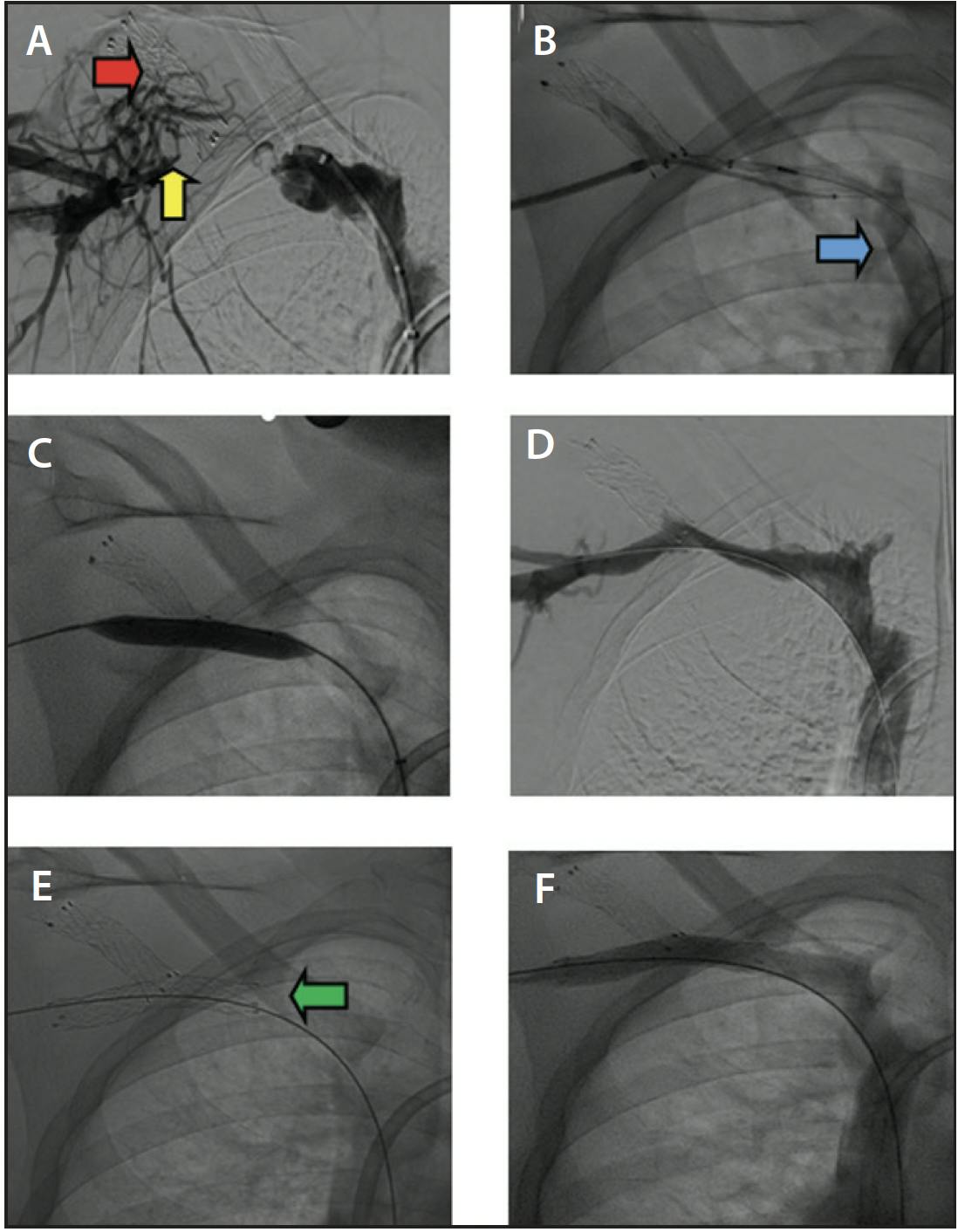
Figure 2. Angiography from simultaneous injections from the sheath in the loop graft access and the sheath in the proximal subclavian vein showing the previously placed cephalic arch stent (red arrow) jailing the occluded axillary/subclavian vein and a string of contrast/stump of the remnant right axillary vein (yellow arrow) (A). Successful crossing of the chronic venous occlusion with contrast opacification of the proximal right subclavian and right brachiocephalic veins (blue arrow) (B). Serial balloon dilation of the occluded segment (C). Angiography showing recanalization of the chronic total occlusion but with significant stenosis and pressure gradient (D). The newly placed 10- X 60-mm Abre stent (green arrow) (E). Completion angiography (F).
Several techniques can be used to cross a chronic venous occlusion. We typically start with a blunt recanalization technique using an angled catheter (Glidecath, Terumo Interventional Systems) over an angled or straight stiff, hydrophilic, 0.035-inch wire (Glidewire, Terumo Interventional Systems). This technique is tried from both access sites until progress is made from one side or the other.
In this particular case, a string of contrast/stump of the remnant right axillary vein was noted from the arm approach (Figure 2A). With the aid of a NaviCross support catheter (Terumo Interventional Systems) in combination with the back end of a straight stiff, hydrophilic, 0.035-inch Glidewire, most of the occluded segment was crossed. Often, the hardest part of the recanalization technique is breaking the fibrous cap at the opposite end of the occluded segment. Sometimes, sharp techniques are used in these situations, including the back end of a stiff wire or a sharp needle with a target placed at the opposite end (a balloon or an undeployed vascular plug). In this case, the back end of a stiff Glidewire and an Amplatzer vascular plug (Abbott) target were used. Rotational fluoroscopy was performed to ensure that the wire and the target were in the same plane. Once the wire crossed into the expected patent portion of the vein, the catheter was advanced over the wire, and the location of the catheter tip was confirmed with gentle contrast injection (Figure 2B). At this point, through-and-through access was obtained (arm to groin) by snaring the wire from the arm using a 15-mm Amplatz GooseNeck snare (Medtronic).
Highlight Point
If sharp recanalization techniques are used (ie, the stiff end of a wire or sharp needle), intraluminal passage of the wire needs to be confirmed with intravascular ultrasound (IVUS) before proceeding to balloon venoplasty to avoid rupture, which could result in hemothorax or pericardial tamponade.
CASE CONTINUED
Prior to venoplasty, IVUS evaluation of the occluded segment was performed with a 6-F IVUS catheter (0.018-inch Visions PV, Philips) to ensure no extravascular path was taken during the sharp recanalization step. Systemic heparin was administered to the patient prior to balloon venoplasty, with frequent activated clotting time (ACT) checks to maintain an ACT goal of > 250 seconds. Serial balloon venoplasty of the occluded axillary and subclavian vein segment was then performed with 8-, 10-, and 12-mm balloons (Figure 2C). Despite high-pressure balloon venoplasty, there was a persistent recalcitrant stenosis at the level of the cephalic arch stent jailing the axillary/subclavian vein, with a 51 mm Hg pressure gradient across the stenosis (Figure 2D). Therefore, a 10- X 60-mm Abre self-expanding nitinol stent (Medtronic) was deployed across the recanalized segment; stent sizing was determined by IVUS measurements of the normal veins measured at both ends of the occlusion (Figure 2E).
Highlight Point
A snared through-and-through wire externalized from sheaths in both the arm and the leg is advised after crossing the lesion and prior to treatment (body flossing method). This allows for simultaneous countertraction on the wire, resulting in a rail system for easier delivery of balloon catheters and/or stents.
CASE CONCLUSION
Completion venography demonstrated successful restoration of inline flow, with excellent flow centrally and decompression/nonvisualization of the numerous neck and chest wall collaterals (Figure 2F). The pressure gradient across the previously occluded segment decreased from 51 mm Hg to 0 mm Hg. Postprocedurally, the patient was placed on clopidogrel 75 mg daily for 2 months and apixaban 5 mg twice daily for at least 6 months, depending on stent patency. She is successfully dialyzing, and her CVC has since been removed. Beyond regular surveillance of flows during HD, imaging follow-up will include CTV of the chest or conventional central venography at 6-, 12-, and 24-month intervals to assess stent patency. If the stent remains patent after 6 months, a trial of holding the direct oral anticoagulant agent can be performed 4 weeks prior to the next surveillance study.
Highlight Point
Prior to balloon dilation of a chronically occluded venous segment, covered stents should be in the room and available for immediate deployment in the case of vein rupture, which cannot be managed with prolonged balloon venoplasty, especially in the setting of a patent ipsilateral AVF/AVG (arterialized blood flow). If the occluded segment needs to be stented, stent sizing with IVUS is crucial. IVUS also better delineates normal healthy vein that can be used to determine the landing zone; the stent must land into healthy vein for better patency.
Highlight Point
After stenting, antiplatelet and anticoagulation therapy is used. Our protocol is antiplatelet therapy with clopidogrel 75 mg daily for 2 months followed by aspirin 81 mg for life (unless there is a contraindication). In addition, anticoagulation with a direct oral anticoagulant is implemented for a duration of 6 months or longer, depending on results of surveillance imaging and need for additional interventions.
SUMMARY
This case sheds light on the evolving challenges with the current dialysis access landscape. As the prevalence of patients on HD increases, cases like this will similarly increase. It is our responsibility as providers to help our patients navigate and chose the best options when building and maintaining a vascular access. Although some may have abandoned this graft and arm, due diligence allowed for salvage, eventual catheter removal, and therefore, a potential reduction in morbidity and mortality.
1. National Kidney Foundation. Global facts: about kidney disease. Accessed March 17, 2025. https://www.kidney.org/global-facts-about-kidney-disease
2. The National Forum of ESRD Networks. National ESRD census data. Accessed March 17, 2025. https://esrdnetworks.org/resources-news/national-esrd-census-data/
3. University of California San Francisco. The kidney project: statistics. Accessed March 17, 2025. https://pharm.ucsf.edu/kidney/need/statistics
4. National Institutes of Health, National Institute of Diabetes and Digestive and Kidney Disease, United States Renal Data System. End stage renal disease: chapter 4. Vascular access. Accessed March 17, 2025. https://usrds-adr.niddk.nih.gov/2024/end-stage-renal-disease/4-vascular-access
Advertisement
Advertisement