Advertisement
Advertisement
August 2025
Sponsored by VentureMed Group, Inc.
When Vessel Prep Sets the Rhythm
One regional medical center’s insights on the efficiencies gained with the use of the FLEX Vessel Prep System.
At Spartanburg Regional Medical Center (SRMC), where more than 1,500 arteriovenous (AV) access procedures are performed each year, small inefficiencies can ripple into major workflow disruptions. For Dr. Ari Kramer, Chief of Vascular Access Surgery, and his operating room (OR) team, achieving consistency without adding complexity was a central objective.
“With POBA (plain old balloon angioplasty) alone, we often found ourselves escalating cases—adding stents or switching balloons mid-procedure,” Dr. Kramer recalls. “It disrupted the flow and left too many variables in play.”
The SRMC Vascular Access Program adopted the FLEX Vessel Prep System (FLEX VP; VentureMed Group, Inc.) as its default vessel prep strategy in 2021, which helped streamline their workflow and reduce variability during procedures—resulting in a calmer, more disciplined procedural environment (Figure 1).
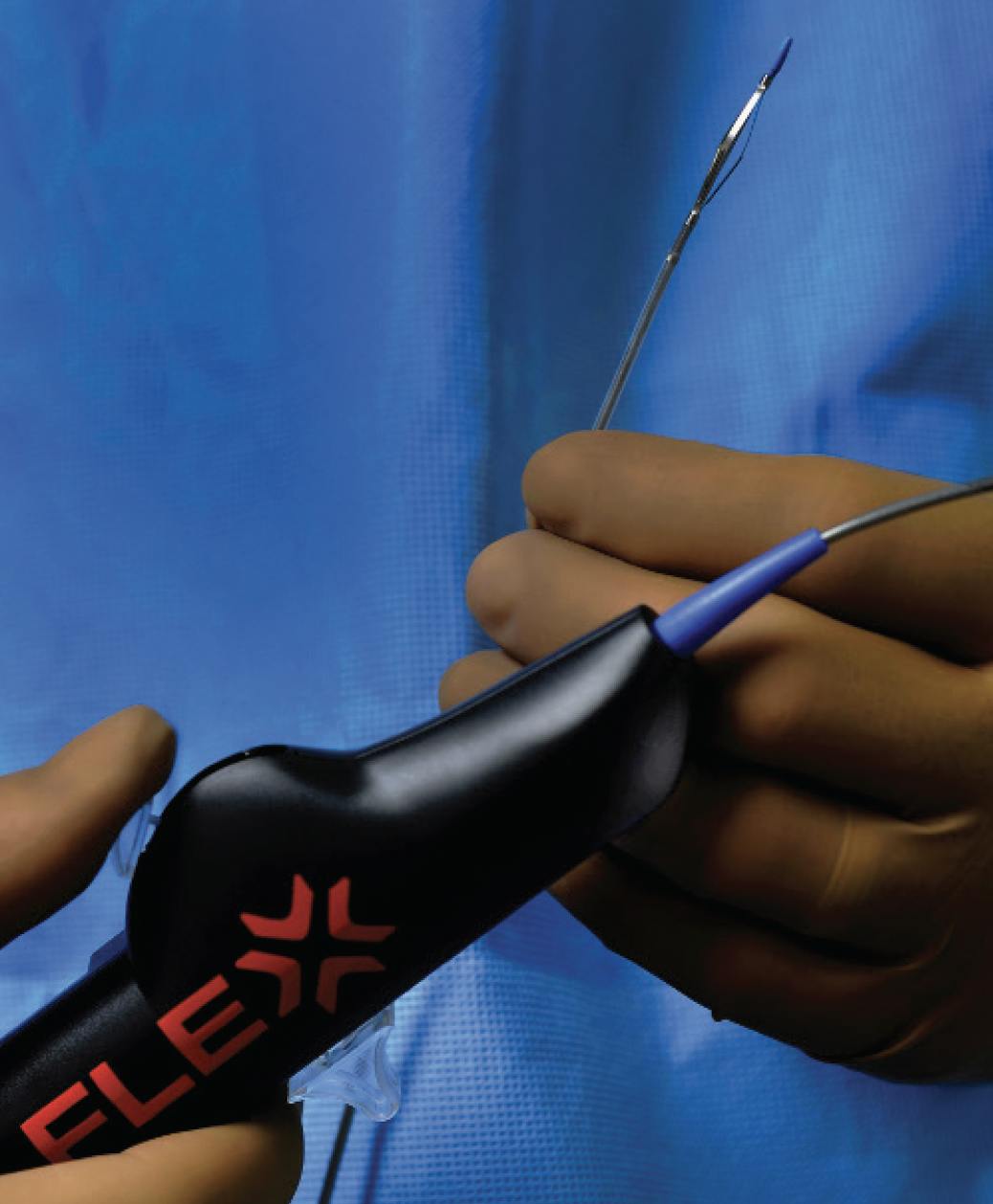
Figure 1. FLEX Vessel Prep System.
SMOOTH INTEGRATION, SHORT LEARNING CURVE
New devices often bring a learning curve, but FLEX VP was different. The Vascular Access Program OR team was surprised at how quickly it fit into their workflow.
“FLEX VP is easy to use and master over time,” one clinical team member notes. “Within just a couple of cases, I felt comfortable using the device at an optimal level.”
For the Vascular Access Program, this ease of adoption mattered. They needed a solution that could address tough, recurrent lesions without adding complexity or slowing them down. FLEX VP’s predictable vessel preparation provided exactly that.
PREDICTABILITY OVER SPEED
Although FLEX VP doesn’t necessarily shorten procedure time, it eliminates what the team calls the “chaos factor.” Cases flow more smoothly, with fewer unplanned device swaps or last-minute escalations.
“Speed isn’t always the issue,” Dr. Kramer explains. “It’s about predictability—knowing how the vessel will respond and that we’re not going to hit those friction points mid-procedure. That consistency means escalation becomes the exception—not the norm.”
This predictability has had ripple effects across their workflow. Procedures are more efficient, case flow has stabilized, and anecdotally, there is reduced reliance on ancillary devices. “Our number of stents and overall balloon usage is down,” one OR nurse shares. “Some patients even seem to experience less pain during procedures.”
CLINICAL IMPACT AND OUTCOMES
Since adopting FLEX VP, the Vascular Access Program has seen a notable reduction in reinterventions in some patients—particularly in high-risk cases. “We’ve come to see vessel prep as a form of therapy in its own right,” Dr. Kramer says.
“The mechanical prep with FLEX VP has contributed to improved vessel compliance, which I believe supports more durable balloon angioplasty,” Dr. Kramer further explains. “That foundation sets the stage for better results and has made a measurable difference in our outcomes.”
These results echo the findings of the FLEX FIRST AV Registry, which reported*:
- 70.7% target lesion primary patency (TLPP) at 6 months across all patients
- 75.6% TLPP in AV fistula cases
- 76.3% TLPP in cephalic arch lesions
- 97.7% secondary patency
- Zero serious adverse events
For the Vascular Access Program, the registry data validate what they’ve experienced firsthand. “FLEX VP upgrades POBA’s performance without adding pharmacologic or implant risk,” Dr. Kramer notes. “It’s an elegant solution that’s become a core part in our practice.”
TAMING THE CEPHALIC ARCH
Recurrent cephalic arch stenosis is one of the most notorious challenges in vascular access care. Lesions are often resistant, and restenosis is rapid and relentless. FLEX VP has provided consistent vessel preparation in this difficult region, supporting our smoother procedures (Figure 2).
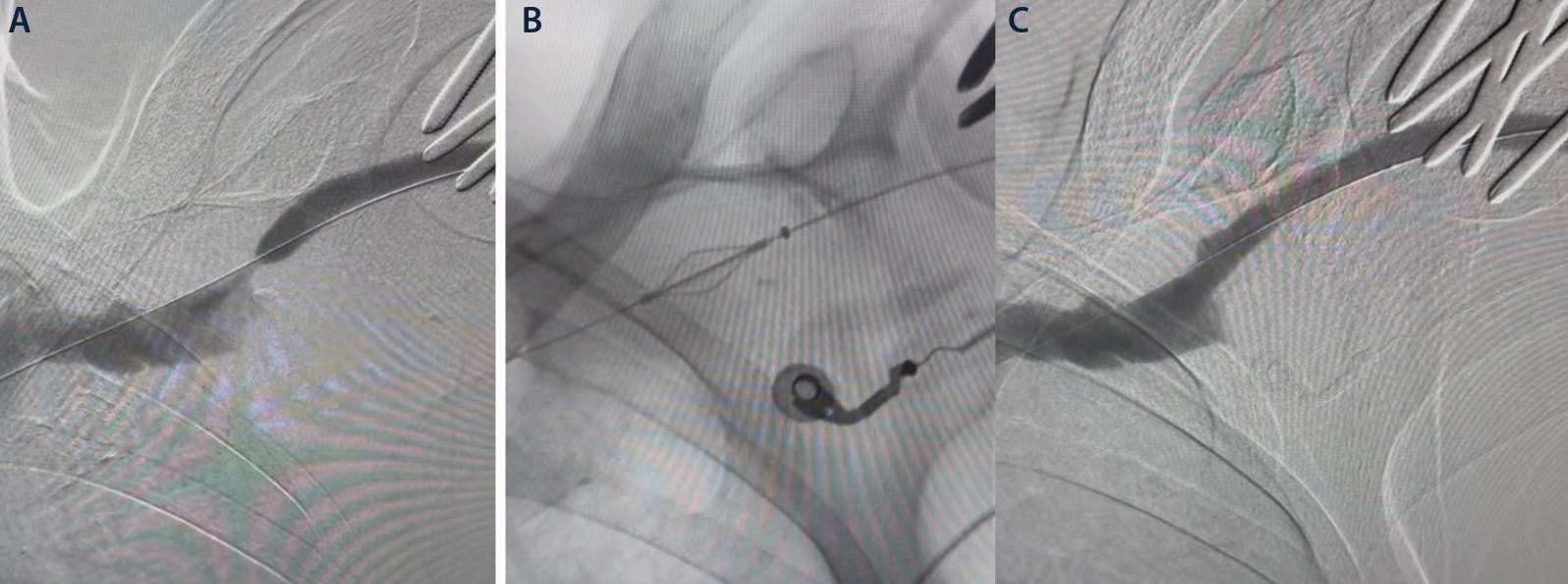
Figure 2. High-grade recurrent cephalic arch stenosis (A). FLEX Vessel Prep device deployed across the lesion (B). Fully effaced treatment zone after vessel preparation and low-pressure balloon angioplasty (C).
“The cephalic arch is where FLEX VP really shines,” Dr. Kramer says. “In our practice, we see far fewer surprises when we prep with FLEX VP first. That consistency in a tough zone means fewer complications and a smoother procedure overall.”
BUILDING CONFIDENCE IN THE OR
Every tool in the OR adds—or detracts from—confidence. For the Vascular Access Program, FLEX VP has minimized procedural variables and improved team dynamics.
“When you have fewer unplanned interventions and less device swapping, the whole case feels calmer,” a senior tech staff member explains. “It’s not just about time saved—it’s about the quality of the workflow.”
That procedural rhythm translates directly to patient care. “We notice some patients with recurrent stenosis aren’t coming back as often when we’ve used FLEX VP,” says Tyler Cunningham, APRN. “For some of our toughest patients, it’s been a game-changer.”
TECHNOLOGY SPOTLIGHT: KEMIC IN PRACTICE
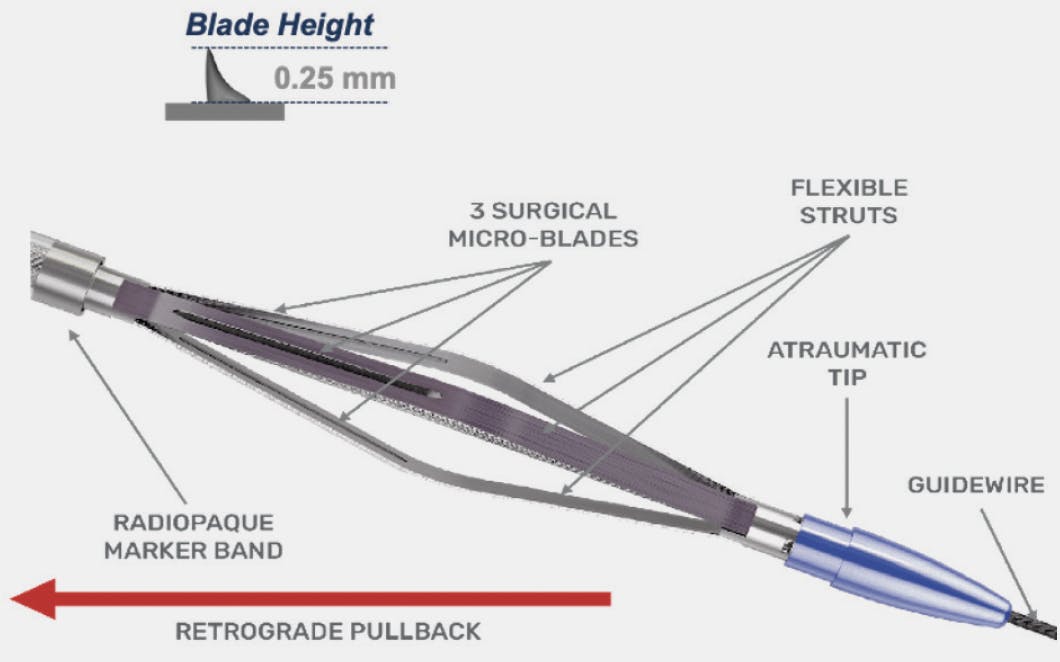
At the heart of FLEX VP is Kinetic Endovascular Micro-Incision Creation (KEMIC) technology—a patented mechanism that uses three micro-blades to create long, controlled micro-incisions through a pullback motion. This precise scoring enhances compliance and prepares the lesion for balloon dilation without the need for pharmacologic agents. For surgeons like Dr. Kramer, FLEX VP offers a consistent and reliable method of vessel preparation that supports procedural efficiency.
A PEER-TO-PEER PERSPECTIVE
When asked what he would tell a colleague about FLEX VP, Dr. Kramer is quick to answer. “It’s easy to adopt, and it’s hard to unsee the difference once you do,” he says. “If you want a more predictable, durable result—without adding drugs or implants—FLEX VP is the way to go.”
For the Vascular Access Program, FLEX VP has shifted vessel prep from an unpredictable variable to a consistent, reliable step. “We now start nearly every complex case with FLEX VP,” Dr. Kramer adds. “It’s become a foundational part of our AV workflow.”
LOOKING AHEAD
As AV access care evolves, the Vascular Access Program team sees FLEX VP not just as a vessel prep tool but as a platform that supports smarter, more efficient care. “It’s about giving the team confidence and giving patients the best chance at a durable outcome,” Dr. Kramer says. “That’s what every clinic is striving for.”
*Data on file, VentureMed Group, Inc.
Advertisement
Advertisement