Advertisement
Advertisement
December 2025 Supplement
Sponsored by Surmodics
An Entirely New Capability: The Pounce™ Thrombectomy Platform for Thromboembolism Removal in Peripheral Arteries
A conversation with Dr. Kevin T. Onofrey.
Kevin T. Onofrey, MD, is a board-certified vascular and general surgeon affiliated with Henry Ford Health in Detroit, Michigan, where he serves as a senior vascular surgeon and Director of Vascular Access. He has authored and coauthored numerous publications in peer-reviewed journals on popliteal artery aneurysm, thoracic endovascular aortic repair, pedal bypass surgery, and other topics. We spoke with Dr. Onofrey about his experience in using the Pounce™ Thrombectomy Platform (Surmodics, Inc.).
Why did you begin using the Pounce™ Thrombectomy Platform?
The Pounce™ Platform addressed an important gap in our endovascular treatment algorithm for limb ischemia by reliably removing subacute and chronic thrombus or embolus in vessels as small as 2 mm in diameter in a single session, without use of thrombolytics. In doing so, it introduced an entirely new capability to our practice.
We previously tried saline-jet and aspiration technologies but found them to be of limited value for many limb ischemia cases. It’s not uncommon for us to see patients with subacute or even chronic presentations, at which point their thrombus may have become fibrotic, collagenized, and wall-adherent, which can make the thrombus very difficult to aspirate. There is also the issue of blood loss with aspiration.1 The Pounce™ Platform provides a fully mechanical, nonaspiration approach that effectively removes this organized material.
The Pounce™ Platform covers a broad range of vessel sizes (Figure 1). This allows us to deploy the Pounce™ Platform throughout the lower extremity, including in small distal vessels. The most transformative device for us has been the Pounce™ Low-Profile (LP) Thrombectomy System (Surmodics, Inc.), which can be used throughout the tibial and even pedal arteries for planned interventions or distal embolization events. In my very first use of this device, we were able to remove emboli from the distal peroneal artery and restore inline flow to the foot for a patient who had been advised to undergo below-the-knee amputation.2
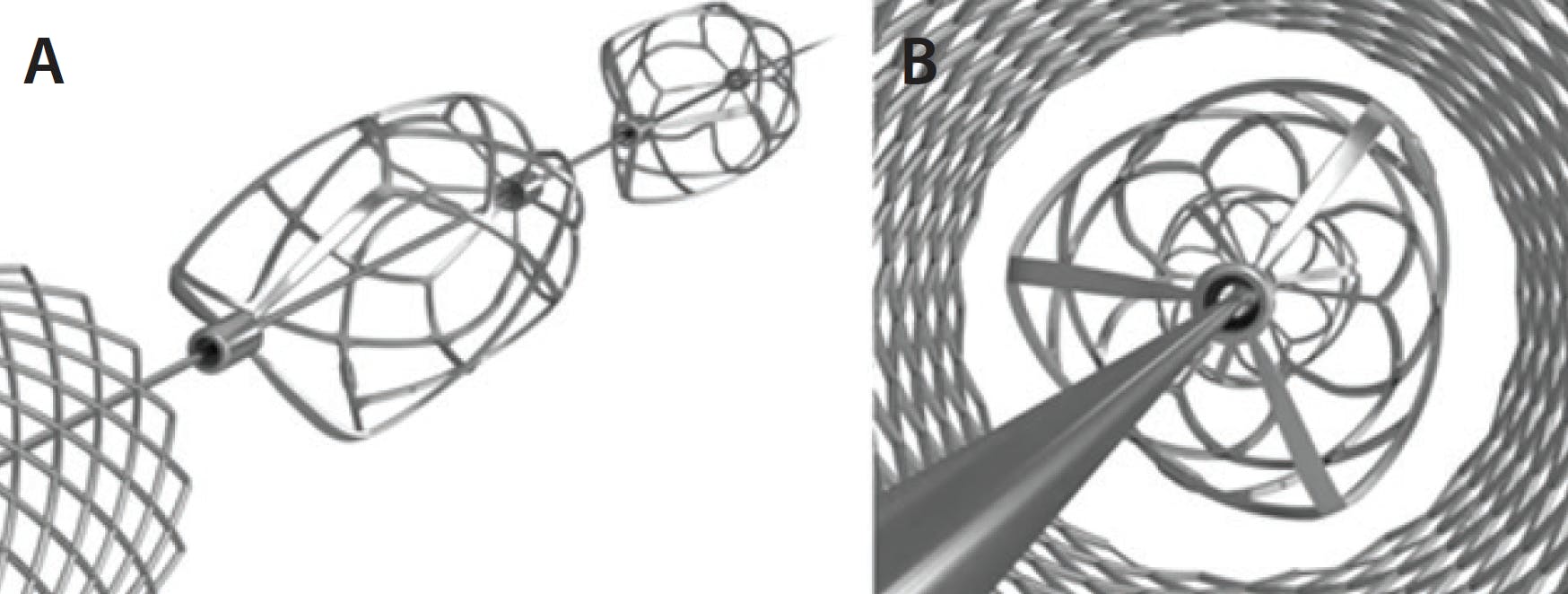
Figure 1. Lateral (A) and axial (B) view of Pounce™ Thrombectomy System showing offset basket and dense mesh pattern for clot capture.
How have you tried to remove distal emboli in the past?
Before the Pounce™ LP System, I primarily attempted saline jet thrombectomy devices combined with chemical thrombolysis and, as salvage, hybrid over-the-wire Fogarty catheters as my option for distal embolization. However, advancing either of these modalities far enough into the pedal arteries to fully remove clot was challenging and sometimes impossible. When I could not fully remove these emboli, I resorted to thrombolysis—often requiring up to 72 hours of treatment without guaranteed durable outcomes. The Pounce™ LP System can be delivered deep into the pedal tree and arch to retrieve emboli. This capability transformed our treatment algorithm, allowing us to remove emboli mechanically and avoid thrombolytics.
What do you prefer about the Pounce™ Platform compared with the Artix™ Thrombectomy System (Inari Medical)?
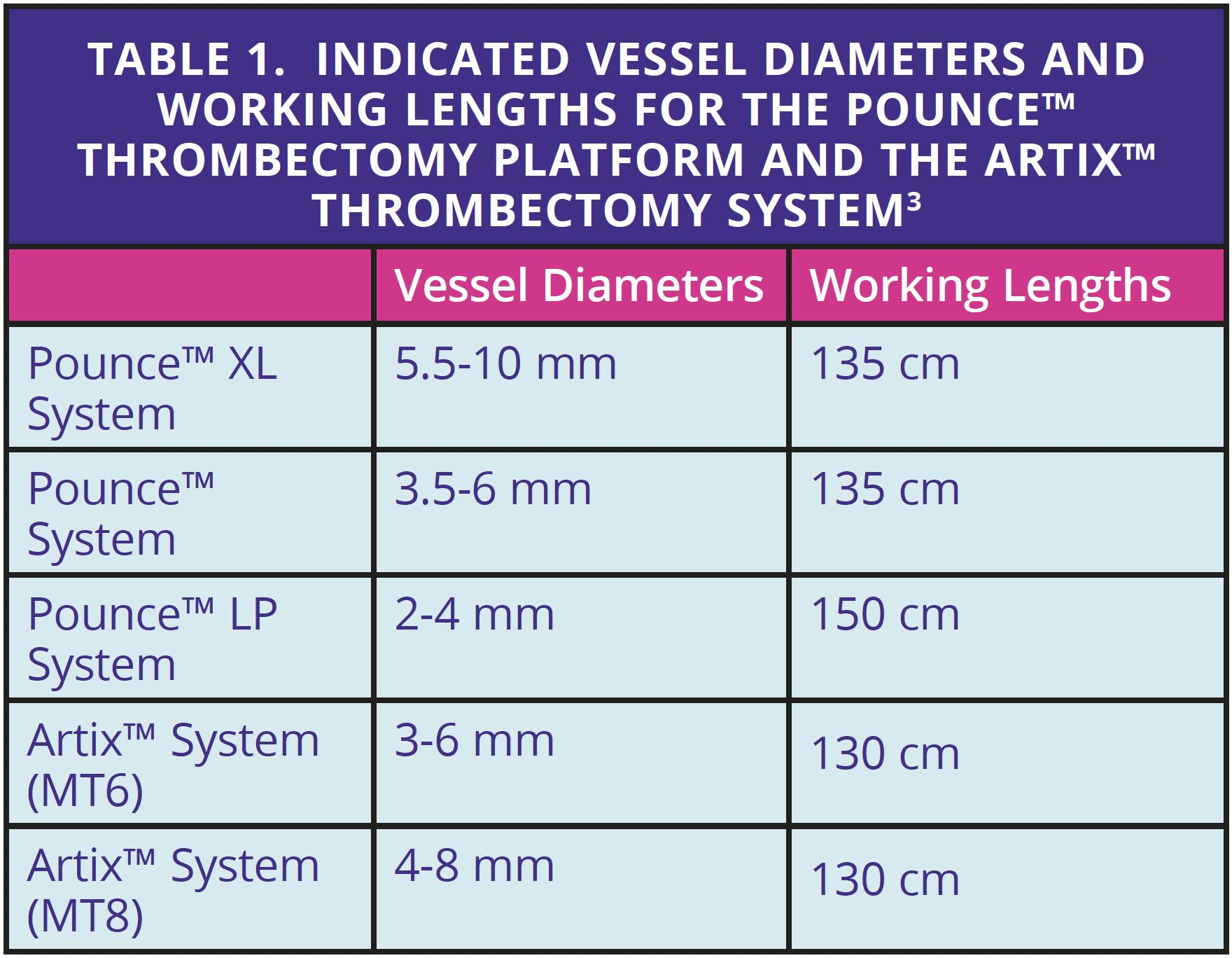
The Pounce™ Thrombectomy Platform can be used in a broader range of vessel diameters and has longer working lengths (Table 1).3 This allows me to deliver a device where I need to for the vast majority of my patients. If I can cross an occlusion with a wire, I’m confident I can deliver a Pounce™ Platform for treatment.
I also appreciate the ability to use the Pounce™ Platform with the conventional 7 Fr guiding sheath I’m accustomed to instead of a dedicated 8 Fr sheath. The sheath I use is easy to deliver and features the detachable valve options that I prefer.
Finally, I appreciate the Pounce™ Platform dual-basket design, with two similarly sized nitinol baskets positioned at different clock orientations along the wire to create a dense mesh pattern for clot capture (Figure 1).
All of my partners have now adopted the Pounce™ Platform into their practice. The trainees ask us why these devices weren’t available sooner. It seems like a no-brainer to them, and they advocate for their use with other practitioners.
Is there any way to improve the Pounce™ Platform?
The Pounce™ Platform is currently a fixed-wire design, where the baskets are mounted on a core wire that is substituted for the procedural guidewire. In my experience, if you’re able to cross a clot with your wire easily at the start of the procedure, the fixed-wire design is not an issue. If the initial wire crossing is difficult, I would be concerned about losing wire access; however, these situations are often unsuited for mechanical thrombectomy in the first place. For example, if you have a chronic total occlusion with a hibernating clot in the middle, you shouldn’t expect a mechanical thrombectomy device to replace an atherectomy device and remove the atheroma stenosing the vessel. The tool isn’t intended for that purpose.
Are there situations in which the fixed-wire design of the Pounce™ Thrombectomy Platform may be advantageous?
The Pounce™ Platform allows you to perform angioplasty with .035 percutaneous transluminal angioplasty (PTA) catheters over the basket wire without having to substitute a guidewire. This can be very useful. For example, a patient with history of repaired popliteal artery aneurysm presented to us with an occluded interposition vein graft, with thrombus extending into the femoral artery. I treated the thrombus using the Pounce™ Thrombectomy System (Surmodics, Inc.) with a standard “Pac-Man” technique, working proximally to remove clot in pieces with small passes until reaching the thrombus cap at the graft. Without removing the Pounce™ basket wire, I was then able to advance a PTA balloon catheter over the basket wire to dilate the diseased segment within the graft. This streamlined the procedure and allowed for rapid treatment of the underlying disease without the added step of swapping in a procedural wire.
You mentioned use of the Pounce™ Platform in the upper extremity. Could you expand on this capability?
The small size of the Pounce™ LP System lends itself to upper extremity thrombectomy (see the following Case Report). I’ve also found that the large size of the Pounce™ XL System (indicated for 5.5-10 mm vessels) (Surmodics, Inc.) provides distinct advantages for treating subclavian artery disease, especially right at the origin near the aortic arch. When I’m using the “Pac-Man” technique and clearing clot in the proximal vessel, the funnel catheter can be positioned to capture clot that might otherwise travel into branches distal to the clot, such as the vertebral artery. The same can be said when using the Pounce™ Platform for treating larger iliofemoral lesions, where the funnel catheter can be deployed to help prevent clot from entering the profunda artery, and for treating tibioperoneal trunk lesions, where the funnel catheter can be deployed to prevent clot from entering the tibial artery.
Caution: Federal (US) law restricts the Pounce™ Thrombectomy System to sale by or on the order of a physician. Please refer to the product’s Instructions for Use for indications, contraindications, warnings, and precautions. SURMODICS, POUNCE, and SURMODICS and POUNCE logos are trademarks of Surmodics, Inc. and/or its affiliates. Third-party trademarks are the property of their respective owners.
1. Maldonado TS, Powell A, Wendorff H, et al. Safety and efficacy of mechanical aspiration thrombectomy for patients with acute lower extremity ischemia. J Vasc Surg. 2024;79:584-592. doi: 10.1016/j.jvs.2023.10.062
2. Chamseddine H, Halabi M, Shepard A, Kabbani L, Onofrey K. Limb salvage using Pounce LP mechanical thrombectomy system after failed open and percutaneous thromboembolectomy. J Vasc Surg Cases Innov Tech. 2025;11:101935. doi: 10.1016/j.jvscit.2025.101935
3. Inari Medical. Artix Spec Sheet. Accessed December 12, 2025. https://www.inarimedical.com/artix-system
Case Report: Upper Extremity Thrombus Removal Using the Pounce™ LP Thrombectomy System
By Kevin T. Onofrey, MD
PATIENT PRESENTATION AND DIAGNOSTIC FINDINGS
A female patient in her 70s with a history of atrial fibrillation, hyperlipidemia, prior deep vein thrombosis, diabetes mellitus, breast cancer treated with chemoradiation, and chronic venous insufficiency presented with ST-segment elevation myocardial infarction and acute heart failure. After percutaneous coronary intervention, an expanding hematoma developed at the left common femoral artery access site. Balloon-assisted hemostasis from the left radial artery access failed. Following an unsuccessful attempt to deliver a covered stent from the radial access site, a covered stent was successfully deployed via an 8 Fr sheath from superficial femoral artery (SFA) access to achieve hemostasis. The initial covered stent system became lodged in the radial artery, necessitating a longitudinal incision to ligate and explant the stent and remove the delivery system. Upon completion, absent pulses and Doppler signals were evident proximal to the brachial artery, and angiography confirmed thrombus in the brachial artery (Figure 1A).
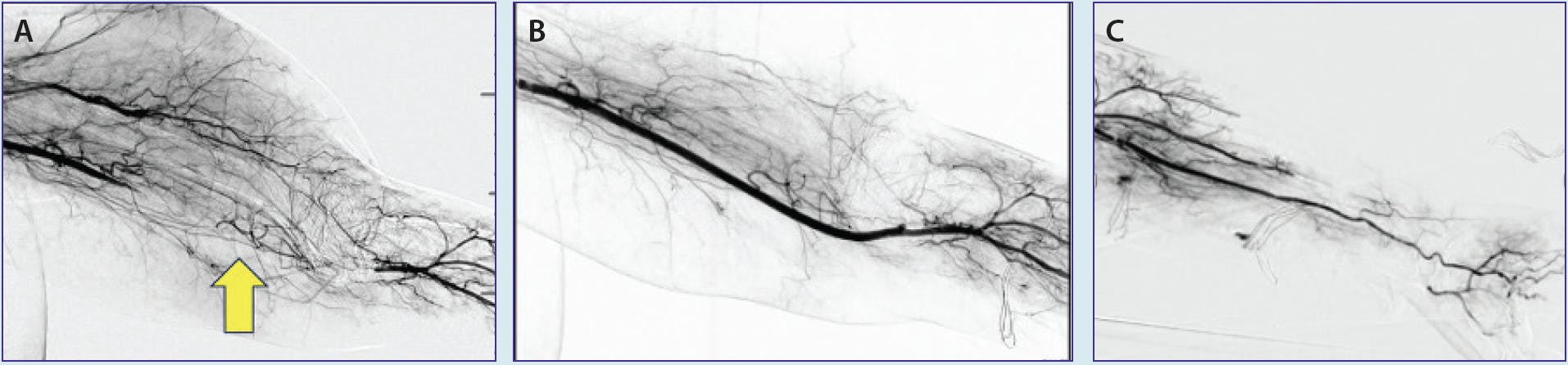
Figure 1. Angiography showing brachial artery thrombus (arrow) (A). Flow restored after two passes with Pounce™ LP System (B). Flow restored to the hand (C).
TREATMENT
The left subclavian, axillary, and brachial arteries were cannulated via the left SFA sheath. The sheath was exchanged for a long, 8 Fr sheath, and the lesion was crossed with a soft .035 Glidewire® Guidewire (Terumo Interventional Systems) and NaviCross® Support Catheter (Terumo Interventional Systems). The guidewire was exchanged for a V-18™ Guidewire (Boston Scientific Corporation) to introduce the Pounce™ Low-Profile (LP) Thrombectomy System (Surmodics, Inc.). Two passes with the Pounce™ LP System (20-minute device time) restored flow and salvaged the hand without deficit (Figure 1B and 1C). The left SFA sheath was removed, and an Angio-Seal® VIP Vascular Closure Device (Terumo Interventional Systems) was used for hemostasis.
POSTPROCEDURE OUTCOMES AND PHYSICIAN OBSERVATIONS
The Pounce™ LP Thrombectomy System provided a rapid solution to upper extremity thrombus in a patient with hemodynamic instability secondary to prior cardiac interventions. Its use enabled limb salvage with only 20 minutes of device time.
Caution: Federal (US) law restricts the Pounce™ Thrombectomy System to sale by or on the order of a physician. Please refer to the product’s Instructions for Use for indications, contraindications, warnings, and precautions. SURMODICS, POUNCE, and SURMODICS and POUNCE logos are trademarks of Surmodics, Inc. and/or its affiliates. Third-party trademarks are the property of their respective owners.

Advertisement
Advertisement