Advertisement
Advertisement
February 2025
Sponsored by Medtronic
Advancements in Embolotherapy Techniques


Insights From Dr. Daye: Angioembolization Strategies in Pelvic Trauma
INTRODUCTION
The coil technology was first developed in the 1970s, when stripped guidewires were used to occlude large vessels and aneurysms. Today, coils are among the most used devices for permanent vessel occlusion. When coils are used for vessel occlusion, occlusion effectiveness typically relies on a combination of thrombus formation and mechanical occlusion with tight coil packing. For effective occlusion, there is a fine balance between having a large surface area (through fibers on the coil surface) to promote quicker thrombus formation and high packability to achieve mechanical occlusion. In patients with no major coagulopathy, fibered coils that pack tightly typically provide a better means for faster occlusion through clot formation and long-term occlusion through high packability.
DEVICE SELECTION
When choosing a coil, it is important to consider the indication for embolization, the vascular bed being treated, and the patient’s coagulopathy status. A superselective embolization is generally desired when possible to reduce the vascular territory being sacrificed. In addition, it is important to consider the collateral flow to the vascular bed being embolized. In an end-vessel embolization (eg, in the kidney), the goal should be to perform a superselective embolization to allow for as much nephron sparing as possible. Alternatively, in the bowel, where there is collateral flow through multiple pathways, it is important to consider a front door/back door approach to ensure successful embolization.
CONSIDERATIONS IN PELVIC TRAUMA
Complex pelvic injuries are among the deadliest trauma-related lesions. Exsanguination typically occurs due to bleeding from bone spurs in displaced fractures, injuring adjacent vessels. According to guidelines published by the World Society of Emergency Surgery, angioembolization of the pelvis is typically recommended in hemodynamically unstable patients after peritoneal packing, with or without temporary mechanical stabilization.
CASE EXAMPLE: EMBOLIZATION FOR PELVIC TRAUMA
Patient Presentation
A woman in her late 70s presented after being struck on the right side by a motor vehicle and then dragged for an unknown distance. On presentation to the emergency room, systolic blood pressure was in the 70s. She had a positive FAST (Focused Assessment With Sonography In Trauma) exam in the right upper quadrant and pelvis. The physical exam was notable for an unstable pelvis. A blood transfusion was initiated.
Procedural Overview
The patient was taken emergently to the operating room for pelvic packing, pelvic external fixation, and angiography with embolization. Intraoperative angiography demonstrated multiple tiny foci of active extravasation in the left hemipelvis. Accordingly, the left internal iliac artery was embolized with Gelfoam (Pfizer, Inc.) to stasis, with good angiographic results. The right internal iliac artery was subsequently selected. Angiography demonstrated a large focus of active extravasation in the right pelvis (Figure 1A). A microcatheter was used to select the injured vessel, and multiple 2-mm X 4-cm and 2-mm X 8-cm Concerto™ detachable coils (Medtronic) were deployed, with cessation of extravasation (Figure 1B).
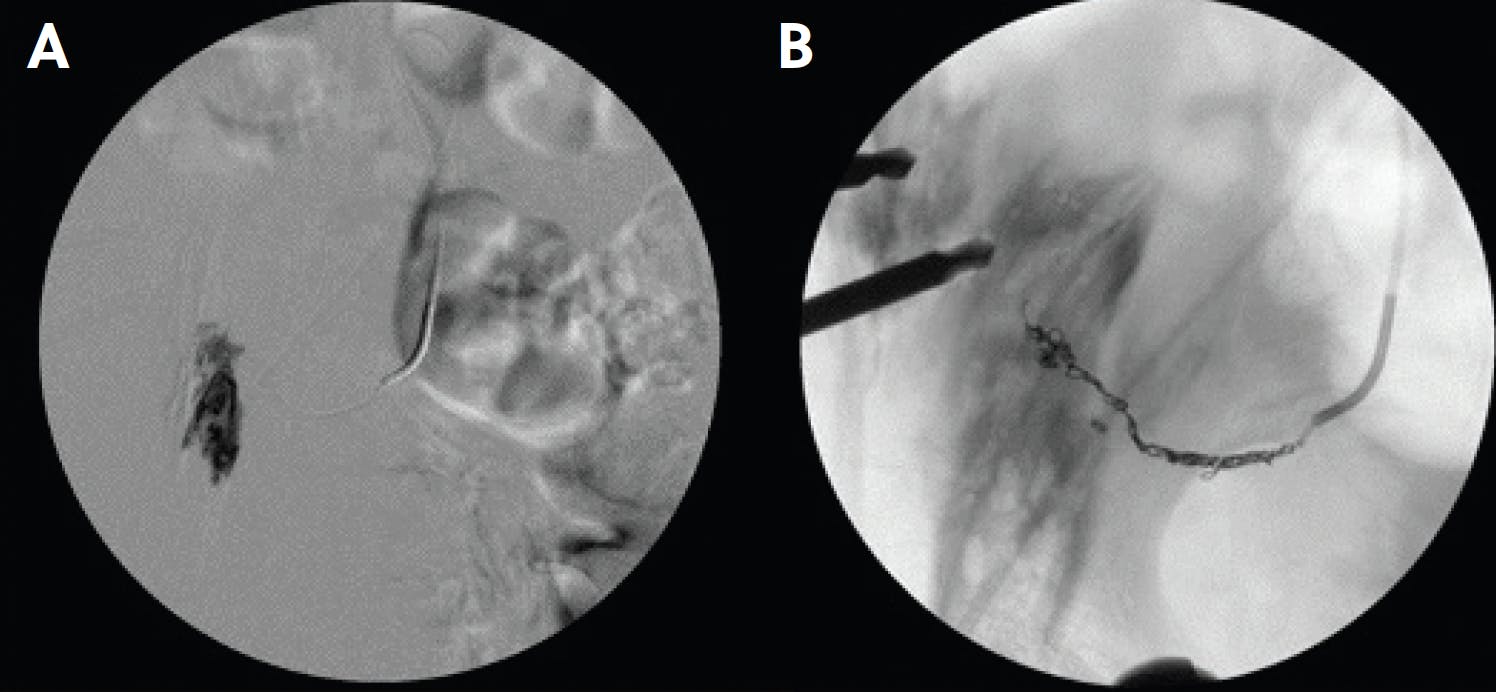
Figure 1. Active extravasation is noted in the right pelvis (A). Cessation of extravasation after coil embolization (B).
Postprocedure and Follow-Up
The patient was hemodynamically stable at the end of the procedure and was transferred to the surgical intensive care unit for further management. She was extubated on postoperative day 5 and was transferred to the surgical ward on day 7 before discharge to inpatient rehab.
CONCLUSION
Knowing the characteristics of each coil will allow for an individualized approach to coil selection for better patient management and outcomes.
Innovations in Hemorrhoid Treatment: Dr. Stewart on Hemorrhoid Artery Embolization
CONSIDERATIONS IN HEMORRHOID ARTERY EMBOLIZATION
The emborrhoid technique, or hemorrhoid artery embolization (HAE), is a method for treating patients with internal hemorrhoids who experience chronic bleeding. In some cases, hemorrhoid-related bleeding can be severe, and patients may become anemic, require blood transfusions, or even become hemodynamically unstable. Hemorrhoids are an extremely prevalent disease, affecting up to 40% of the population and with around 10% of patients eventually requiring surgical management. Hemorrhoidectomy is a notoriously painful surgery that requires significant recovery time. A recent study comparing hemorrhoidectomy to embolization found that there was similar symptom improvement between the groups at 12 months postprocedure.1 There is an opportunity for interventional radiologists to help serve this substantial patient population by offering a minimally invasive treatment for bleeding internal hemorrhoids that avoids the pain and recovery time associated with surgical treatment.
DEVICE SELECTION
Embolization for the treatment of symptomatic internal hemorrhoids involves selection of the superior rectal arteries and/or middle rectal arteries, which supply the arteriovenous network within the hemorrhoids called the corpus cavernosum recti (CCR). A recent meta-analysis found that embolization using both particles and coils had a lower incidence of rebleeding compared to coils alone.2 The vessels supplying the CCR may be small and tortuous, and using a small and trackable microcatheter is helpful in reaching the desired location for a relatively distal embolization. After administration of a small amount of particles to occlude anastomotic connections within the CCR, coils are deployed within the distal artery to prevent recanalization and permanently occlude the artery. The ideal coil for this indication is soft and easy to navigate through tortuous vessels. Given the small size of the distal superior rectal arteries, I have found that microcoils of 2 to 3 mm in diameter produce ideal vessel occlusion at this location.
CASE EXAMPLE: HAE FOR BLEEDING INTERNAL HEMORRHOIDS
Patient Presentation
A man in his early 70s presented with a history of metastatic neuroendocrine tumor treated with Whipple surgery. He also had a history of splenectomy and partial left hepatic lobe resection, as well as known portal hypertension with esophageal and rectal varices. He presented to his primary care provider after experiencing 2 weeks of bright red blood per rectum and dizziness. His systolic blood pressure was in the 90 mm Hg range and his hemoglobin level was 7.5 mg/dL (baseline 11 mg/dL). The patient was sent to the emergency room, where 2 units of packed red blood cells were transfused. The patient remained hemodynamically stable. Flexible sigmoidoscopy revealed moderate-sized internal hemorrhoids. CTA of the abdomen and pelvis revealed no evidence of active extravasation, with rectal varices noted. Despite the presence of rectal varices, after consultation with the colorectal surgery team, it was thought that the bright red blood per rectum was most likely related to the internal hemorrhoids. In addition, the patient was high risk for hemorrhoidectomy given the coexisting portal hypertension and rectal varices. Therefore, a decision was made for the patient to undergo transarterial embolization for treatment of the internal hemorrhoids, as an outpatient.
Procedural Overview
The procedure was performed with moderate sedation via right common femoral arterial access. The inferior mesenteric artery (IMA) was catheterized using a Mikaelsson catheter, and power digital subtraction angiography revealed three branches of the superior rectal arteries supplying the CCR in the hemorrhoidal tissue in the distal rectum (Figure 2A).
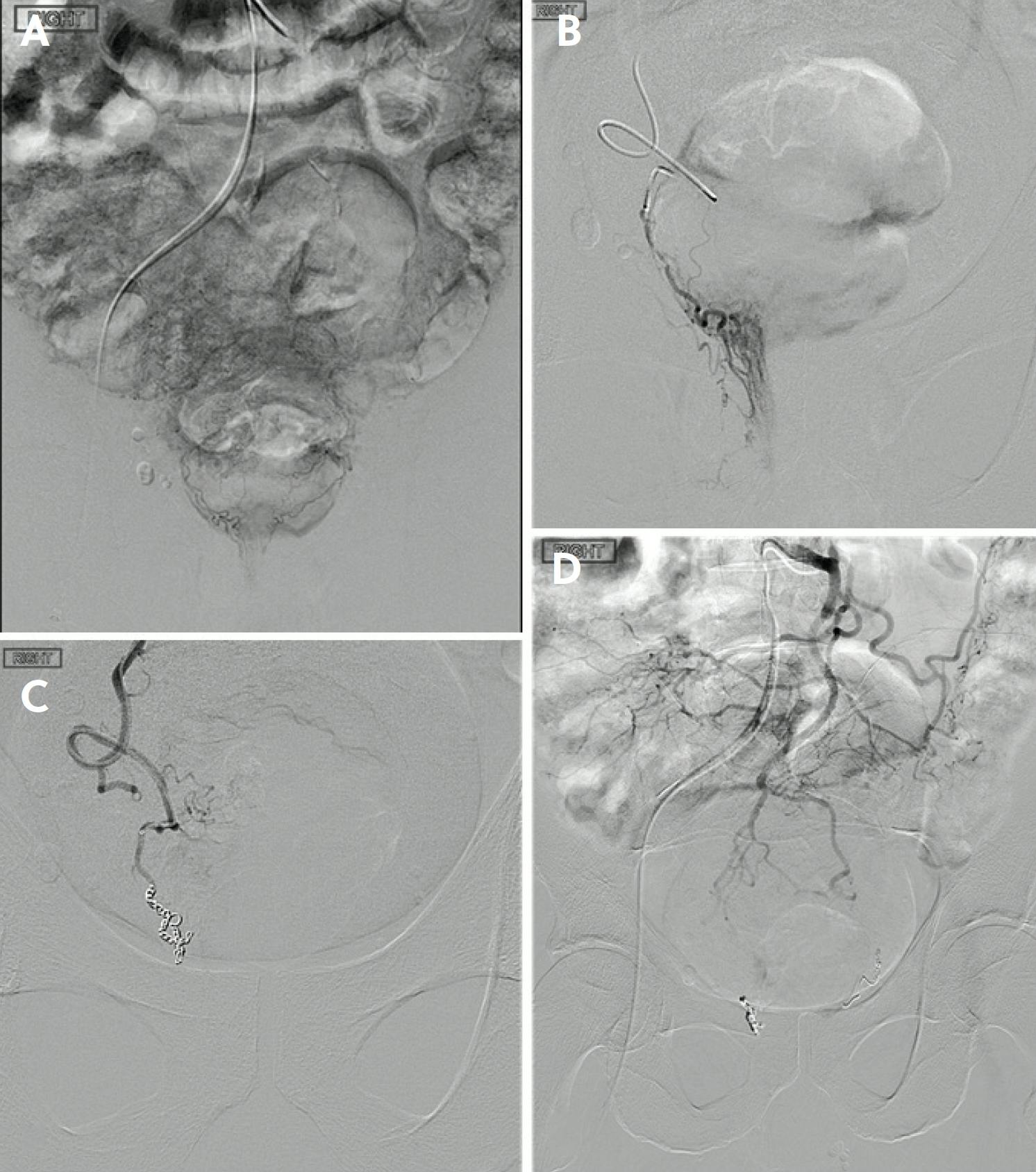
Figure 2. Digital subtraction angiography reveals distal branches of the superior rectal arteries supplying the CCR (A). Selective angiography of the distal right superior rectal artery demonstrates opacification of the CCR at the location of the hemorrhoidal tissue (B). Selective angiography of the distal right superior rectal artery demonstrates complete stasis and absence of opacification of the CCR (C). Completion digital subtraction angiography of the IMA reveals absent opacification of the CCR in the region of the hemorrhoidal tissue (D).
Each of the three dominant branches supplying the CCR was selected using a 2.4-F microcatheter and microwire. Figure 2B and 2C show opacification of the CCR from the right-sided supplying branches of the superior rectal artery before and after embolization, with a small amount of 500–700-µm spherical embolic particles and Concerto coils. This process was repeated for the left-sided branches, and final arteriogram demonstrated no residual opacification of the CCR (Figure 2D). No significant anastomosis to the CCR from the middle or inferior rectal arteries was identified.
Postprocedure and Follow-Up
At 6 weeks postprocedure, the patient had recovered successfully, and his hematochezia had resolved.
CONCLUSION
HAE can offer many patients with bleeding internal hemorrhoids a less invasive but effective treatment as an alternative to surgery. The ideal microcoils for this procedure should be soft, available in small diameters, and easily traverse tortuous vessels.
1. Falsarella PM, Nasser F, Affonso BB, et al. Embolization of the superior rectal arteries versus closed hemorrhoidectomy (ferguson technique) in the treatment of hemorrhoidal disease: a randomized clinical trial. J Vasc Interv Radiol. 2023;34:736-744.e1. doi: 10.1016/j.jvir.2023.01.022
2. Makris GC, Thulasidasan N, Malietzis G, et al. Catheter-directed hemorrhoidal dearterialization technique for the management of hemorrhoids: a meta-analysis of the clinical evidence. J Vasc Interv Radiol. 2021;32:1119-1127. doi: 10.1016/j.jvir.2021.03.548
Disclosures
Dr. Daye: Consultant to Boston Scientific, Cook Medical, Medtronic, and TriSalus.
Dr. Stewart: Consultant to CrannMed, Cook Medical, Medtronic, Terumo Interventional Systems, and Varian.
Concerto™ Helix and 3D detachable coil system
Reference Statement
Important Information: Indications, contraindications, warnings and instructions for use can be found in the product labeling supplied with each device. Not all patients achieve the same results.
Indications for Use: The Concerto™ detachable coil system is indicated for arterial and venous embolizations in the peripheral vasculature.
Potential Adverse Effects of the Device on Health: The potential complications include, but are not limited to, the following: puncture site hematoma, thromboembolic episodes, vessel perforation, neurological deficits including stroke and death, vasospasms, vascular thrombosis, hemorrhage, and ischemia.
CAUTION: Federal (USA) law restricts these devices to sale, distribution and use by or on the order of a physician.
501669 ©2025 Medtronic. Medtronic, Medtronic logo are trademarks of Medtronic. All other brands are trademarks of Medtronic. For global distribution. 02/2025
Advertisement
Advertisement