Advertisement
Advertisement
September 2025
Sponsored by Cordis
Transforming Complex CTO Cases With the OUTBACK™ Elite Re-Entry Catheter
A combined crossing and treatment strategy with the OUTBACK™ Elite Re-Entry Catheter is crucial for optimizing limb outcomes in patients with chronic limb-threatening ischemia.
Successful crossing of chronic total occlusive (CTO) lesions often presents a challenge in the endovascular treatment of patients with chronic limb-threatening ischemia (CLTI).1 Antegrade recanalization is usually attempted first, typically with a guidewire escalation strategy. When antegrade access fails, retrograde puncture of tibioperoneal arteries or occluded stents in the superficial femoral artery (SFA) is the next step, depending on the diameter and quality of distal access sites.2
Access challenges also arise in patients with hostile anatomy, tortuous iliac arteries, or prior aorto-bi-iliac bypass graft surgery, where a transbrachial access may be necessary. In very complex CTO cases, bidirectional techniques—including the use of re-entry devices from antegrade, retrograde, or both antegrade and retrograde sites—may be required for successful lesion crossing, as described in this case.
Successful Double Re-Entry in Patient With CLTI and Prior Aorto-Bi-Iliac Bypass Graft Surgery


CASE PRESENTATION
A man in his early 80s presented with ischemic right-sided rest pain and ulcerations (Rutherford category 5). His medical history included diabetes mellitus, hypertension, hyperlipidemia, coronary artery disease, multiple percutaneous coronary interventions, symptomatic heart failure, and smoking. He also had a history of an aorto-bi-iliac bypass graft and a prosthetic femoropopliteal bypass graft on the right side, performed 6 years earlier.
The ankle-brachial index (ABI) was 0.48 on the right side and 0.78 on the left side. Duplex ultrasound revealed biphasic flow in the right common femoral artery (CFA) and a long, calcified occlusion of the SFA and the prosthetic bypass, with reconstitution at the P1 segment of the native popliteal artery. Blunted monophasic flow was detected in the popliteal artery by duplex ultrasonography.
PROCEDURAL OVERVIEW
The patient was scheduled for endovascular treatment, performed via puncture of the right brachial artery and insertion of a 6-F, 90-cm Destination™ Guiding Sheath (Terumo Interventional Systems) due to the previous aorto-bi-iliac bypass graft surgery. Digital subtraction angiography (DSA) confirmed occlusion of the bypass graft and native femoral artery (Figure 1A), with reconstitution in the P1 segment of the popliteal artery (Figure 1B).
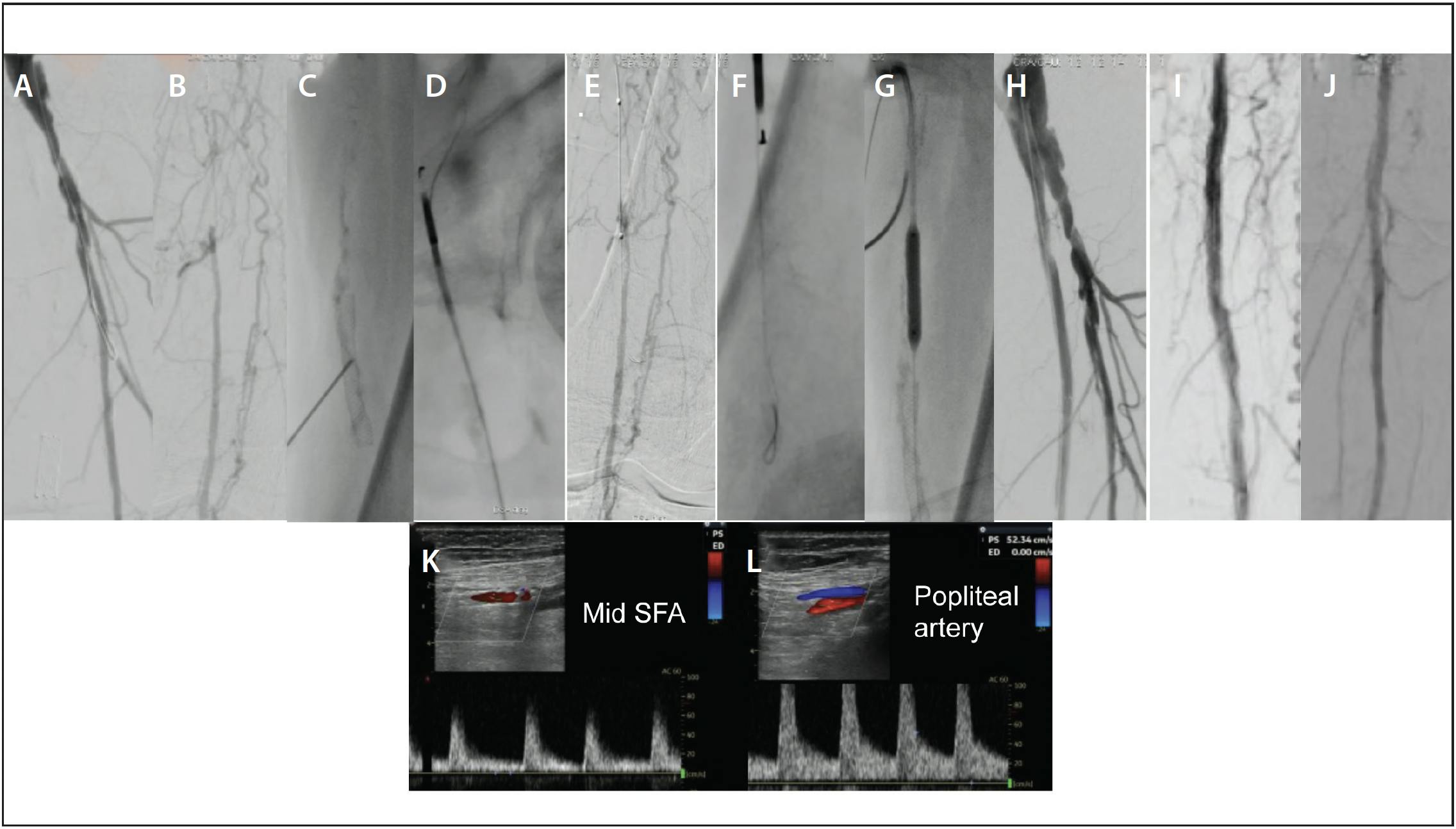
Figure 1. DSA images showing occlusion of the bypass graft and native femoral artery, with reconstitution in the popliteal artery (A, B). After retrograde puncture of an occluded SFA stent (C) and insertion of a 6-F sheath, an OUTBACK™ Elite Re-Entry Catheter enabled re-entry to the CFA true lumen from retrograde (D). Crossing the CTO from antegrade was then attempted and also required use of the re-entry catheter (E, F). After high-pressure balloon angioplasty (G) and placement of bare-metal stents, antegrade flow was restored in the SFA (H-J). Duplex ultrasound imaging (K, L).
An initial antegrade guidewire passage was unsuccessful. Retrograde puncture of the occluded distal femoral stent was then performed (Figure 1C), and a guidewire was advanced through the native femoropopliteal axis from retrograde, although it remained in the subintimal space. A 6-F sheath was inserted retrogradely into the occluded stent, and a long-needle re-entry catheter (OUTBACK™ Elite, Cordis) was used to re-enter the true CFA lumen (Figure 1D).
After externalizing the guidewire, balloon angioplasty was performed in the proximal and mid SFA. Because of the long distance from the transbrachial site to the distal CTO, additional antegrade puncture of the proximal SFA was required, with insertion of a short 6-F sheath. However, the antegrade guidewire again entered the subintimal space, and re-entry into the true lumen of the popliteal artery was not possible, despite guidewire escalation strategies (Figure 1E). The same re-entry catheter was then used from the antegrade approach to achieve successful re-entry into the popliteal artery.
Subsequent treatment included ultra-high-pressure balloon angioplasty (6- X 40-mm Athletis balloon, Boston Scientific Corporation) (Figure 1F), followed by deployment of self-expanding bare-metal stents (Absolute Pro™, Abbott), restoring antegrade flow in the femoropopliteal axis (Figure 1G and 1H) without bleeding at either distal access site.
Duplex ultrasound 24 hours postprocedure showed monophasic flow with good systolic acceleration in the mid SFA and popliteal artery (Figure 1I and 1J). The ABI increased to 0.78, and resting pain resolved. The patient was discharged on dual antiplatelet therapy with aspirin and clopidogrel.
DISCUSSION
The prevalence of peripheral artery disease is increasing, leading to more cases of CLTI that require urgent intervention to prevent amputation. Endovascular treatment is the preferred first-line approach for femoropopliteal disease.3 Contemporary options include plain balloon angioplasty, drug-coated balloons, atherectomy, thrombectomy, and stenting.3 However, all of these depend on successful lesion crossing, which can be technically challenging in long, calcified CTO lesions, like the one described in this case.1,2
In such cases, bidirectional approaches and re-entry devices—used from antegrade or/and retrograde become critical.1 In this patient, retrograde re-entry was performed via an occluded SFA stent. Previous surgery and presumed dense fibrosis around the CFA may have prevented guidewire passage. After retrograde crossing, re-entry into the true popliteal artery lumen was also challenging and required the same re-entry catheter used from the antegrade direction.
Access site limitations further complicated the procedure, especially due to sheath and device length restrictions from the transbrachial approach, necessitating additional antegrade access.
After failed bypass surgery, recanalization of native arteries (when feasible) may be the most effective strategy for long-term patency, rather than repeat open or hybrid procedures.4 A combined approach to crossing and treatment is essential to improve limb outcomes in CLTI patients and should be adopted more widely by centers treating these high-risk individuals.1,3
1. Korosoglou G, Schmidt A, Lichtenberg M, et al. Crossing algorithm for infrainguinal chronic total occlusions: an interdisciplinary expert opinion statement. JACC Cardiovasc Interv. 2023;16:317-331. doi: 10.1016/j.jcin.2022.11.036
2. Trenkler C, Blessing E, Jehn A, et al. Retrospective case control matched comparison of the antegrade versus retrograde strategy after antegrade recanalisation failure in complex de novo femoropopliteal occlusive lesions. Eur J Vasc Endovasc Surg. 2024;67:799-808. doi: 10.1016/j.ejvs.2023.12.037
3. Korosoglou G, Schmidt A, Lichtenberg M, et al. Global algorithm for the endovascular treatment of chronic femoropopliteal lesions: an interdisciplinary expert opinion statement. JACC Cardiovasc Interv. 2025;18:545-557. doi: 10.1016/j.jcin.2024.11.038
4. Korosoglou G, Torsello G, Saratzis A, et al; ENSUPRO Collaborative. Editor’s choice - endovascular versus surgical treatment for all comer patients with prosthetic bypass graft occlusion: the multicentre ENSUPRO study. Eur J Vasc Endovasc Surg. 2024;67:786-796. doi: 10.1016/j.ejvs.2023.07.054
This article has been developed for an educational purpose and represents independent evaluations and opinions of the authors and contributors independently from the operating company sponsoring this article.
Prof. Korosoglou & Prof. Andrassy are compensated by and presenting on behalf of Cordis and must present information in accordance with applicable regulatory requirements.
For Healthcare Professionals Only
Important information: Prior to use, refer to the instructions for use supplied with this device for indications, contraindications, side effects, suggested procedure, warnings and precautions. As part of its continuous product development policy, Cordis reserves the right to change product specifications without prior notification. CORDIS, Cordis LOGO, OUTBACK are trademarks of Cordis and may be registered in the US and/or in other countries. All other marks are the property of their respective owners.
© 2025 Cordis. All Rights Reserved. 100666526
CE 2797
Advertisement
Advertisement