Advertisement
Advertisement
January 2026 Supplement
Sponsored by Inquis Medical, Inc.
Real-World Insights From Early Adoption of the AVENTUS® Thrombectomy System
Integrated directional aspiration, navigation, and TrueClot™ Sensing technologies and streamlined blood return deliver practical benefits in pulmonary embolism cases.
As Director of the Pulmonary Embolism Program at CentraCare Heart and Vascular Center, I have had the pleasure of working with multiple specialties to develop a comprehensive, nationally recognized program for the treatment of acute pulmonary embolism (PE). The multidisciplinary team works closely to deliver seamless, 24/7 cardiopulmonary care from emergency intervention through recovery and follow-up of patients with PE. Our innovative, patient-centric care model helps ensure that Central Minnesotans have access to the most advanced cardiovascular treatment options close to home.
To provide patients with the most cutting-edge care, it is important for the team to have access to the latest innovations in PE treatment to provide high-quality care to all patients promptly and efficiently. As a top enroller in the AVENTUS Trial, we have developed expertise with the new AVENTUS® Thrombectomy System. This article outlines the device’s features that have made an immediate impact in our PE cases through improvements in procedural efficiency and outcomes.
FAST AND EFFICIENT CLOT BURDEN REDUCTION WITH LARGE-BORE DIRECTIONAL ASPIRATION
Procedural efficiency is very important in our PE cases to optimize patient outcomes, physician time, and hospital resources. These patients are often very sick, so achieving timely hemodynamic and respiratory stability is important. Further, in a busy catheterization laboratory, the ability to complete a mechanical thrombectomy (MT) PE procedure from access to closure in under an hour can be valuable in critically ill patients. The AVENTUS Thrombectomy System enables this in several ways.
First, the directional aspiration catheter allows you to efficiently extract clot by predictably facing toward the clot and away from the vessel wall. This results in a higher rate of successful aspirations and avoiding suction on the vessel wall (wall latch), which solves one of the issues with end-hole aspiration catheters that can mimic a clot “lollipop” scenario. Taking this one step further, TrueClot™ Sensing technology allows you to immediately identify whether the catheter is approximated to vessel wall or clot, allowing for improved procedural efficiency and less uncertainty when suction is maintained after aspiration. This is especially important in the left pulmonary artery (PA) which, due to is abrupt posterior/inferior course, can lead to frequent wall-latch events with end-hole aspiration catheters. The beveled aspiration opening provides the ability to ensure the aspiration opening is appropriately positioned (Figure 1) and eliminates the need for curved or accessory catheters. This innovation addresses one of the historical issues of procedural efficiency with MT and adds predictability during clot aspiration.
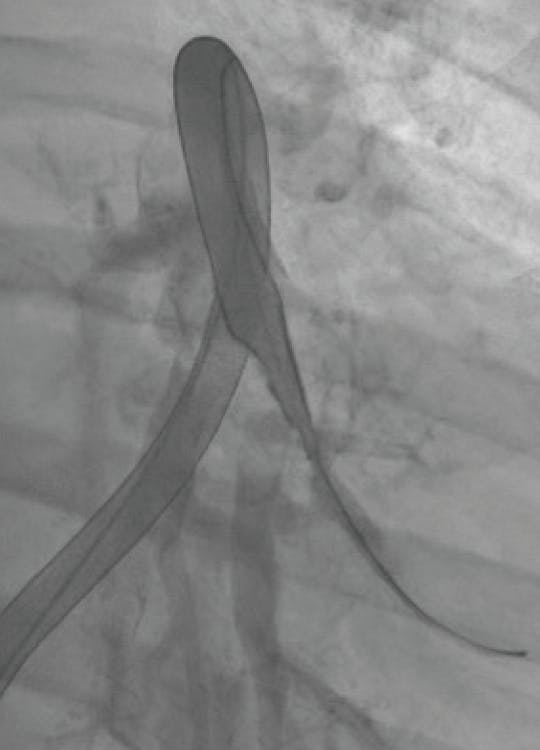
Figure 1. AVENTUS Catheter opening positioned posterior, directly at clot in the left basilar branches of the PA.
Second, directional aspiration allows for targeted branch aspiration without the need to individually wire side branches. This is achieved by facing the aspiration opening toward the branch and directing suction to mobilize and remove the clot. A great example of this is residual clot in the truncus anterior (Figure 2A), which can frequently be aspirated by maintaining original wire access and appropriate catheter position without the requirement of wiring and engaging the branch. The catheter is highly torqueable and visible under fluoroscopy, making alignment with side branches simple and enabling “drive-by aspiration” as you are working either proximally or distally (Figure 2B).
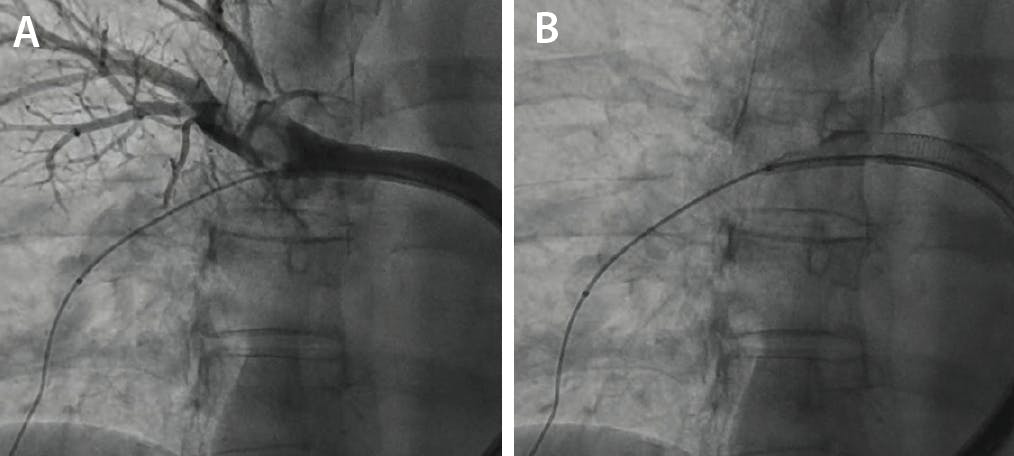
Figure 2. Residual clot in the truncus anterior. Fluoroscopic image showing the AVENTUS Catheter position without exchanging devices (A). AVENTUS Catheter aligned with the ostium of the truncus anterior while maintaining original wire position for a “drive by” aspiration (B).
Finally, the 24-F beveled catheter provides efficient aspiration in cases with high clot burden with very low rates of catheter clogs or lollipops. The beveled design of the aspiration opening not only provides directionality, but it also increases the surface area of the opening versus an end-hole design. This allows clot to easily enter the catheter, reducing the likelihood of lollipop scenarios.
REDUCING PROCEDURE TIME THROUGH EFFICIENCIES IN TRACKING AND NAVIGATION
One pain point with other aspiration systems is that they require the exchange of a dilator to safely advance the aspiration catheter through the PAs. To minimize device exchanges, many operators will choose a distal location to begin aspiration and work proximally to avoid the need to readvance the catheter. However, with end-hole catheters, if there is residual distal clot burden, you need to exchange for the dilator and readvance. With AVENTUS, the operator can start at the level of greatest clot burden and work proximally or distally as residual clot burden and anatomy dictates without additional procedural steps.
Further, because the AVENTUS System offers directional aspiration, in the vast majority of cases, you can place your guidewire into a lower lobe of the left or right PA and leave it in one position for all aspirations on that side (Figure 3). This helps reduce procedural time and complexity by limiting guidewire manipulation and the need to advance into side branches to aspirate clot.
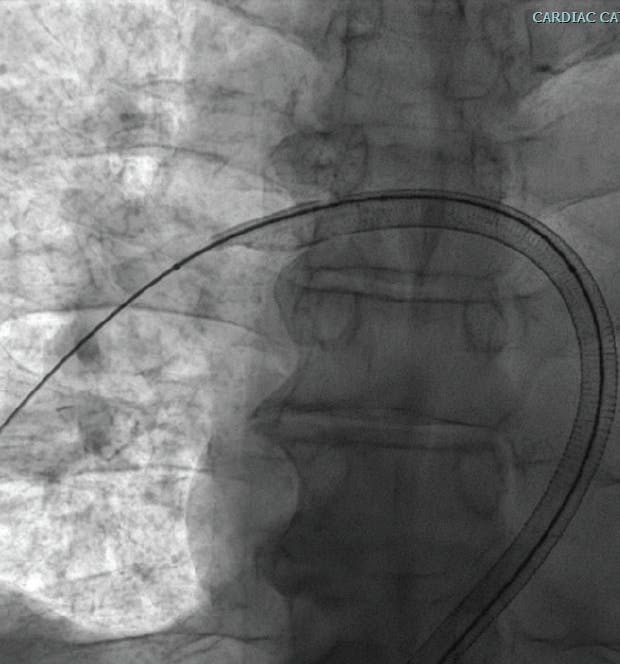
Figure 3. Guidewire positioned in the distal branches of the right lower lobe. The physician is free to work back and forth without exchanging for a dilator or moving guidewire position.
If you must change guidewire position, it's done very easily by pulling back the integrated navigation catheter while leaving roughly 3 cm of your soft guidewire extended distally. The shape of the navigation catheter allows you to easily select new vessels quickly and readvance the catheter if needed. The ease in this technique is highlighted when switching from the right PA to the left PA. With this method, the soft guidewire will naturally flop into the left PA when pulling the AVENTUS Aspiration Catheter back into the trunk of the main PA, enabling catheter advancement in the left PA without any additional wire or dilator exchanges (Figure 4). These features save a considerable amount of time by reducing procedural steps, enabling treatment with one catheter, and reducing time spent manipulating guidewires and catheters.
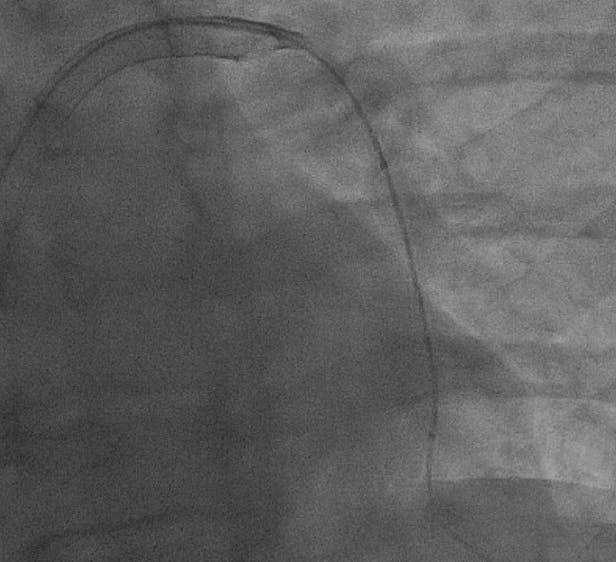
Figure 4. AVENTUS Catheter positioned in left PA with aspiration opening pointed away from wall and to the center of the lumen. Access in left is gained without guidewire and dilator exchanges.
UTILIZING TRUECLOT™ SENSING TO ELIMINATE GUESSWORK
In our cath lab, we are always trying to limit unnecessary aspiration and contrast injections. TrueClot™ Sensing provides the ability to have confidence that the aspiration you performed mobilized clot and progress through your procedure with fewer unnecessary aspirations and procedural steps. Furthermore, while large-bore aspiration does not require direct contact with the clot to provide successful aspiration, TrueClot™ Sensing allows for awareness of clot position near the aspiration opening for prompt extraction (Figure 5).
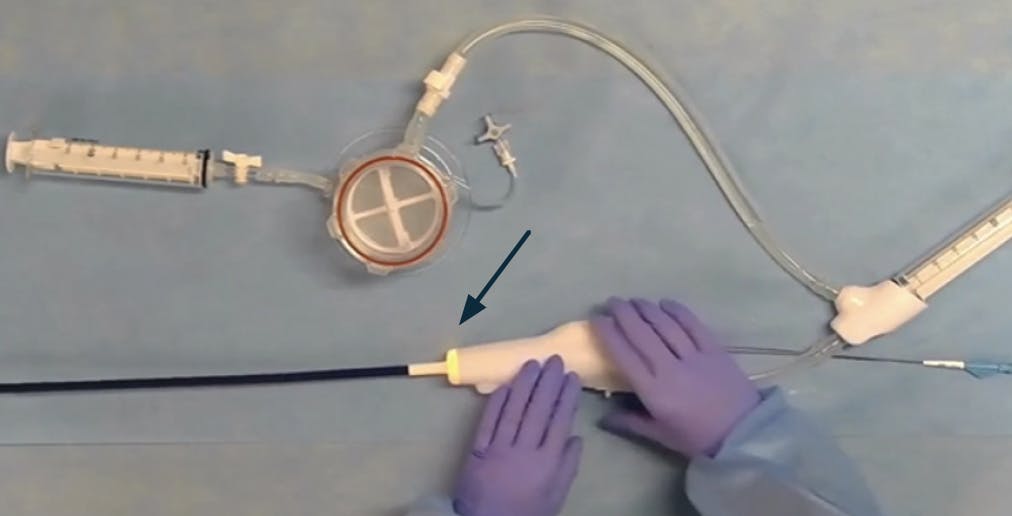
Figure 5. TrueClot™ Sensing is indicating contact with clot by showing an orange light (arrow). Green indicates contact with only blood, and blue indicates a vessel wall latch.
Where TrueClot™ Sensing has shown particular clinical benefit is helping identify what is at the catheter tip during suspected wall latches versus clot lollipop scenarios. With other MT systems, when the catheter is obstructed and aspiration vacuum is maintained, it is difficult to confidently know whether you have a wall latch or a clot lollipop. This leads to additional mitigation steps that lead to procedural inefficiency. With TrueClot™ Sensing, we instantly know if the catheter is obstructed by the vessel wall or clot to act accordingly. This information is extremely valuable to complete the case as quickly and efficiently as possible.
STREAMLINED CLOT FILTRATION AND BLOOD REINFUSION
Blood loss in MT procedures is not always insignificant, which can lead to drops in hemoglobin levels, require consideration for transfusions, extend hospital length of stay, or lead to attenuation of improvement in symptoms that aspiration thrombectomy provides. In some cases, blood loss can result in suboptimal outcomes, increases in health care costs, and increased length of stay, all of which can compromise patient outcomes and increase cost of hospitalization. The integrated AVENTUS Blood Reinfusion System allows for simple, safe, and efficient blood return and is one of only two large-bore aspiration systems with FDA approval for blood reinfusion.
The AVENTUS Blood Reinfusion System is a big step forward in simplifying blood return. The aspiration syringe remains connected throughout the procedure, eliminating the need to disconnect and have an assistant independently filter blood for reinfusion. This eliminates the back-and-forth handling of blood, which is required by some blood return systems. This is accomplished by dual one-way valves in the aspiration syringe that extracts blood and clot when pulled back and sends aspirated material to the clot canister when the syringe plunger is advanced forward. Clot is filtered with dual filters, ensuring only filtered blood is collected ( Figure 6).
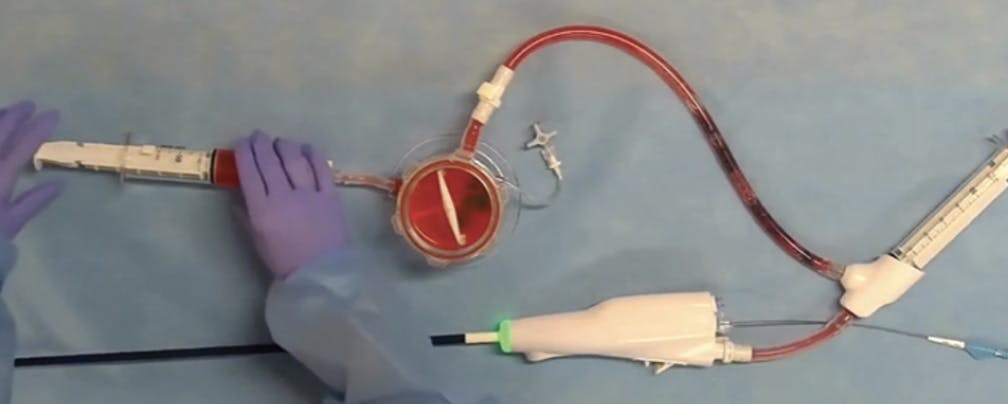
Figure 6. Blood filtration and reinfusion done at the patient bed. The contained and clean system simplifies blood reinfusion.
Overall, both my staff and I appreciate how blood return is streamlined with the AVENTUS System. It allows us to feel we are doing everything in our power to optimize the outcome of each individual patient and ensure they leave the hospital in a condition that is as close as possible to how they felt prior to their PE. Sometimes, especially in our sickest patients, every drop truly matters.
INDICATIONS FOR USE
The Aventus Thrombectomy System is indicated for:
- The non-surgical removal of emboli and thrombi from blood vessels.
- Injection, infusion, and/or aspiration of contrast media and other fluids into or from a blood vessel.
The Aventus Thrombectomy System is intended for use in the peripheral vasculature and for the treatment of pulmonary embolism.
The Aventus Clot Management System is indicated for use with the Aventus Thrombectomy System for autologous blood transfusion.
AVENTUS® is a registered trademark of Inquis Medical, Inc.
©2025 Inquis Medical, Inc. All Rights Reserved.

Advertisement
Advertisement