Advertisement
Advertisement
January 2026
Sponsored by Medtronic
Redefining Mechanical Thrombectomy Through Ultrasonic-Controlled Aspiration

Mechanical thrombectomy, or the removal of thrombus without the use of pharmacologic agents, has expanded over the past decade as more devices come to market and studies demonstrate clinical benefit.1,2 Several devices that either incorporate a rheolytic component or utilize a mechanism that scrapes against the vessel wall carry a risk of endothelial damage, including valve damage or vessel collapse.2,3 Alternatively, aspiration devices use suction and are without the risk of vessel wall damage, but they can often clog or lead to excessive blood loss. Blood loss mitigation tools and monitoring blood collection volume can reduce the need for transfusions during treatment.4
There are several FDA-cleared aspiration thrombectomy devices available on the market. Devices such as Lightning Bolt™* and Lightning Flash™* (Penumbra, Inc.) use aspiration with computer-aided technology to improve blood conservation. The Prodigy™* line (Imperative Care) employs aspiration and maceration to extract thrombi or emboli with a “deep pulse” algorithm designed to minimize blood loss. The Flowtriever™* (Inari Medical) employs a large-bore catheter to aspirate thrombus, which can be filtered and then returned to the body.
THE LIBERANT™ THROMBECTOMY SYSTEM
The Liberant thrombectomy system (Medtronic) is a mechanical endovascular aspiration device that is designed to restore blood flow by removing fresh, soft emboli or thrombi from vessels of the peripheral arterial and venous systems (Figure 1). It is currently available in several catheter sizes, including 6, 8 (short and long), and 12 F for use in a variety of vessel diameters (Figure 2A), with smaller and larger sizes in development. Each catheter set includes a sterile, single-use, guidewire-compatible catheter; dilator; clotbuster; aspiration tubing; and hemostasis valve.
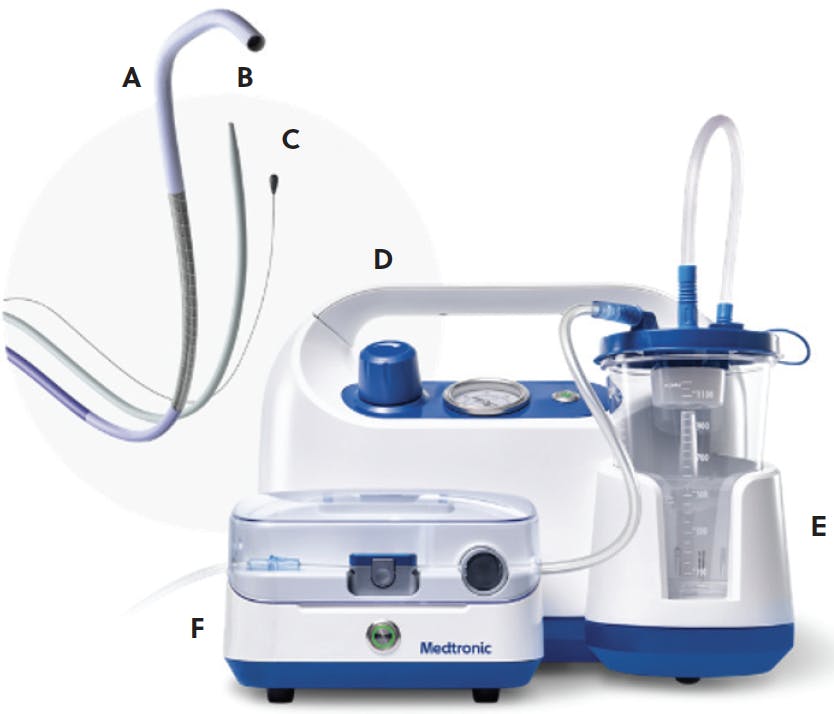
Figure 1. Liberant thrombectomy system and capital components: 12-F catheter (A), dilator (B), clotbuster (C), Riptide aspiration pump (D), cannister (E), BCU (F).
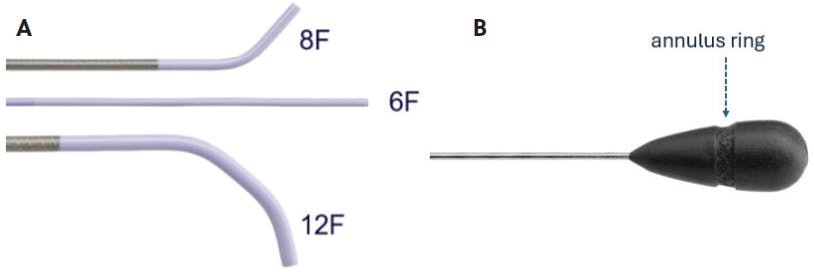
Figure 2. Liberant system catheter tip shapes: straight, 6 F; single-angled, 8 F; and doubleangled, 12 F (A). Liberant system clotbuster bulb (B).
INNOVATIONS BEHIND THE LIBERANT SYSTEM
The Liberant thrombectomy system was developed through extensive physician input and literature review to address key needs: blood loss, catheter performance, deliverability, and clot disruption. These priorities guided its design and rigorous testing, resulting in targeted features to address shortcomings within the thrombectomy market.
Blood Loss Management
The Liberant thrombectomy system consists of both capital and disposable components. The Liberant blood conservation unit (BCU) is an ultrasonic-controlled, reusable, nonsterile electronic device with consistent pulse rate automation in all catheter sizes (Figure 1E). The Liberant system is the only device on the market that uses an ultrasonic flow sensor to directly measure blood flow and automatically adapt the rate of aspiration, using a pinch valve to mitigate blood loss. The Liberant BCU has two modes of operation: standard mode to minimize blood loss and maintain a lower pulse rate and boost mode for procedural efficiency with an increased pulse rate. It was designed to both reduce blood loss and maximize efficiency via the ultrasonic direct flow reading capabilities as well as the dual-mode options (standard and boost). The Liberant BCU is provided as capital equipment and is compatible with the Riptide™ aspiration system (Medtronic) and blood collection canister.
Catheter Performance
The distal portion of the Liberant catheters has a hydrophilic coating to ensure smooth delivery to the target site and radiopaque marker bands for increased fluoroscopic visibility. The catheter shaft features a hybrid braid coil design. The hybrid braid coil allows for flexibility and reduced kinking while maintaining a 1-to-1 torque to transverse tortuous vasculature.† The catheters come in three French sizes and lengths:
- 8 F short (50 cm)
- 8 F long/12 F (115 cm)
- 6 F (135 cm)
Figure 2A illustrates the available catheters with three size-dependent tip shapes: straight (6 F), single-angled (8 F), and double-angled (12 F). The Liberant thrombectomy system catheters are designed to maximize retention of their tip shape after use, ensuring reliable vessel navigability.†
Deliverability
To improve delivery, the Liberant system includes a dilator, respective of each catheter size, to provide a smooth transition between the tip and the shaft (Figure 1B). The radiopaque dilator also provides insertion support to the catheter and guidewire. The dilator is compatible with 0.035-inch guidewires to allow flexibility in the treatment of the peripheral, venous, and arteriovenous vessels.
Clot Disruption
Each Liberant catheter comes packaged with an optional radiopaque clotbuster (Figure 1C), which is designed to assist with thrombus fragmentation and clearing the catheter lumen. The teardrop shape increases resistance while the annulus ring of the clotbuster bulb (Figure 2B) is designed to aid in clot engagement by increasing friction during fragmentation.
EXCIPIO™* THROMBECTOMY DEVICE
The Excipio thrombectomy devices (Medtronic) are rapid-exchange catheters with a mechanical basket designed to be used within an aspiration catheter (Figure 3), like the Liberant system. It can be used to assist with additional clot disruption and removal. The nitinol expandable basket can be adjusted to various sizes based on the target vessel anatomy. The basket is easily opened and closed via a physician-controlled slider mechanism on the handle. The Excipio device comes in three sizes: SV for small vessels (4-8 mm), LV Prime for vessels 6-16 mm, and LV for vessels 10-25 mm. The fully expanded nitinol basket diameters are 8, 16, and 25 mm. The SV is compatible with the Liberant 8-F system, and the LV Prime is compatible with the Liberant 12-F system.
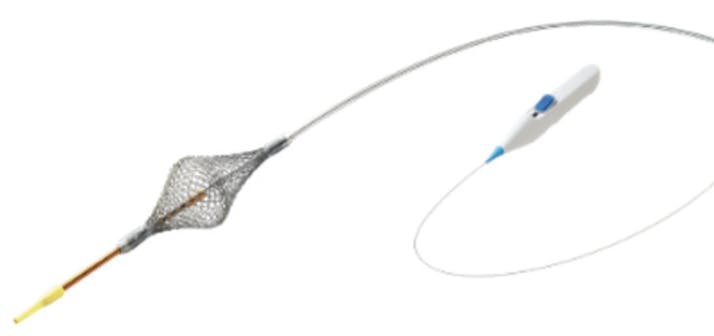
Figure 3. Excipio thrombectomy device.
The Liberant system and the Excipio device are symbiotic and complementary devices. While the Liberant system is used for initial thrombus removal, the Excipio device can be used as an adjuvant for effective clot disruption and removal.
PHYSICIAN PERSPECTIVE
There is not one device on the market that (1) effectively removes thrombus within all arterial and venous vascular beds, (2) is easy to use, and (3) minimizes blood loss. However, the Liberant system was designed with these goals in mind and is based on extensive physician feedback from multiple specialties.
The various smaller sizes allow for more complex areas of thrombectomy, including below the knee for arterial venous and upper extremity veins. With additional catheter sizes in development, larger vessels and locations can be targeted, allowing one device to function throughout the body. The catheter angles may allow for access techniques such as up-and-over within the iliac bifurcation. Particularly, the double-angled catheter tip will be a nice addition to the thrombectomy line.
Most thrombectomy devices come with a form of blood conservation, but not all are created equally. The ultrasonic-controlled BCU has the ability to measure blood flow directly and vary the rate of aspiration to minimize blood loss while maximizing thrombus removal. Mitigating blood loss has a large influence on patient morbidity, particularly when trying to minimize transfusions. I’m excited to see how the new Liberant system can impact my clinical results and patient outcomes.
1. Bulman JC, McNamara SL, Weinstein JL, et al Utilization of arterial and venous thrombectomy in the United States: a 6-year evaluation of Medicare claims. J Am Coll Radiol. Published online October 31, 2025. doi: 10.1016/j.jacr.2025.09.007
2. Raychev R, Saver JL. Mechanical thrombectomy devices for treatment of stroke. Neurol Clin Pract. 2012;2:231-235. doi: 10.1212/CPJ.0b013e31826af206
3. Dmytriw AA, Musmar B, Salim H, et al; MAD-MT Consortium. Incidence and clinical outcomes of perforations during mechanical thrombectomy for medium vessel occlusion in acute ischemic stroke: a retrospective, multicenter, and multinational study. Eur Stroke J. 2024;9:328-337. doi: 10.1177/23969873231219412
4. Ogbonna B, Monroe E, Shin D, et al. Venous thrombectomy: device landscape and applications. Clin Imaging. 2025;121:110462. doi: 10.1016/j.clinimag.2025.110462
†Internal data on file.
Disclosures
Dr. Keefe: Consultant to Medtronic and Centerline Biomedical.
Liberant™ thrombectomy system Reference Statement
Indications for Use:
The Liberant thrombectomy system is indicated for the removal of fresh, soft emboli or thrombi from the vessels of the peripheral arterial and venous systems.
Contraindications:
Do not use the Liberant thrombectomy system in the coronary vasculature or neurovasculature. Do not use in patients for whom anticoagulant or antiplatelet therapy is contraindicated.
Potential Adverse Effects of the Device on Health:
The potential complications include, but are not limited to the following: allergic reaction to device materials; anemia; death; embolization; hemorrhage; hypotension; infection; ischemia or infarction; pain; thrombosis; total occlusion of treated vessel; venous valvular damage; vessel damage, including arteriovenous fistula, dissection, perforation, pseudoaneurysm, or vascular aneurysm; adverse events associated with endovascular procedures, including acute renal impairment, allergic reaction to contrast medium, cerebrovascular accident, hemorrhage or hematoma at access site, hypertension.
Indications, contraindications, warnings and instructions for use can be found in the product labeling supplied with each device, or by contacting a Medtronic representative.
Integrated Risk Statement
Risks include, but are not limited to, embolization, hemorrhage, thrombosis, and vessel damage.
Excipio™* SV Thrombectomy Device Reference Statement
Indication for Use
The Excipio SV Thrombectomy Device is indicated for the non-surgical removal of soft emboli and thrombi from peripheral blood vessels.
Contraindications
- Not intended for use in the coronaries or the neurovasculature.
- Do not use on patients with known hypersensitivity to nickel-titanium.
Potential Adverse Effects
Possible complications include, but are not limited to the following: access site complications, allergic reaction, arterial dissection, arterial thrombosis, death, distal embolization of blood clots and atherosclerotic plaque, hematoma, hemorrhage, ischemia, infection, perforation and/or vessel rupture, tip separation and distal embolization, vasospasm.
Indications, contraindications, warnings and instructions for use can be found in the product labeling supplied with each device, or by contacting a Medtronic representative.
Excipio™* LV and LV Prime Thrombectomy Devices Reference Statement
Indications for Use:
The Excipio LV Thrombectomy Device and Excipio LV PRIME Thrombectomy Device are indicated for the nonsurgical removal of emboli and thrombi from peripheral blood vessels.
Contraindications
Not intended for use in the coronary arteries, pulmonary vasculature or neurovasculature.
Do not use on patients with known hypersensitivity to nickel-titanium.
Potential Adverse Effects; Possible complications include, but are not limited to the following: access site complications, acute occlusion, allergic reaction, arrhythmia, anemia, death, hematoma or hemorrhage at access site, hemorrhage, hypotension, inability to completely remove thrombus, intimal disruption, ischemia, infection, renal impairment or acute renal failure from contrast media, thromboembolic events, tip separation and distal embolization; vessel spasm, thrombosis, dissection, or perforation.
Indications, contraindications, warnings and instructions for use can be found in the product labeling supplied with each device, or by contacting a Medtronic representative.
501898 ©2026 Medtronic. Medtronic, Medtronic logo are trademarks of Medtronic. TM* third party brands are trademarks of their respective owner. All other brands are trademarks of Medtronic. For distribution in the US only. 01/2026
Advertisement
Advertisement