Advertisement
Advertisement
August 2022
Challenging Mechanical Thrombectomy to Manage an Internal Carotid Artery–T Occlusion
Moderator: Ajit S. Puri, MD;
Panelists: Muhammad Shazam Hussain, MD, FRCP(C); Peter T. Kan, MD; and Katyucia de Macedo Rodrigues, MD
CASE PRESENTATION
A female patient in her late 70s with a medical history of multiple sclerosis, atrial fibrillation, and atrioventricular block after pacemaker implantation presented from an outside hospital. Her National Institutes of Health Stroke Scale score was 15. CT of the head showed a right hyperdense middle cerebral artery (MCA) sign (Figure 1 and Figure 2). CTA showed a right internal carotid artery (ICA)–T occlusion (Figure 3 and Figure 4).
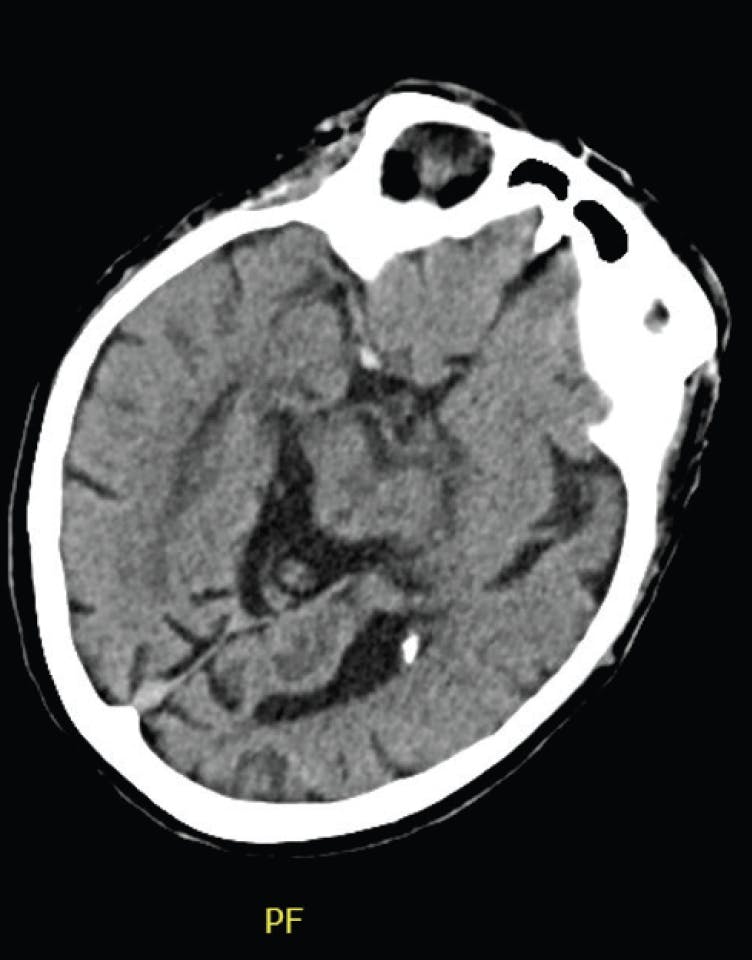
Figure 1. Noncontrast CT of head shows a hyperdense MCA sign on the right side.
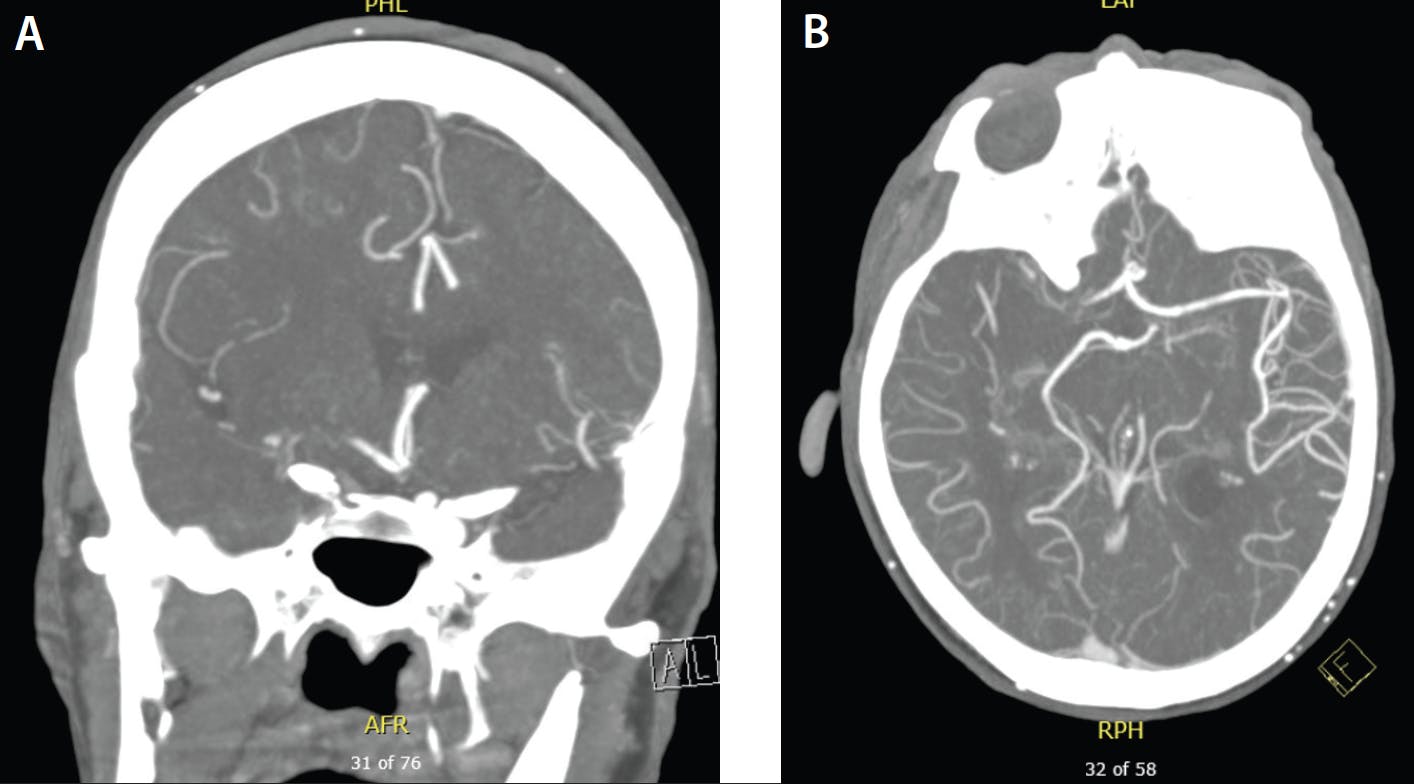
Figure 2. Coronal (A) and axial (B) maximum intensity projection (MIP) images showing a right ICA-T occlusion.
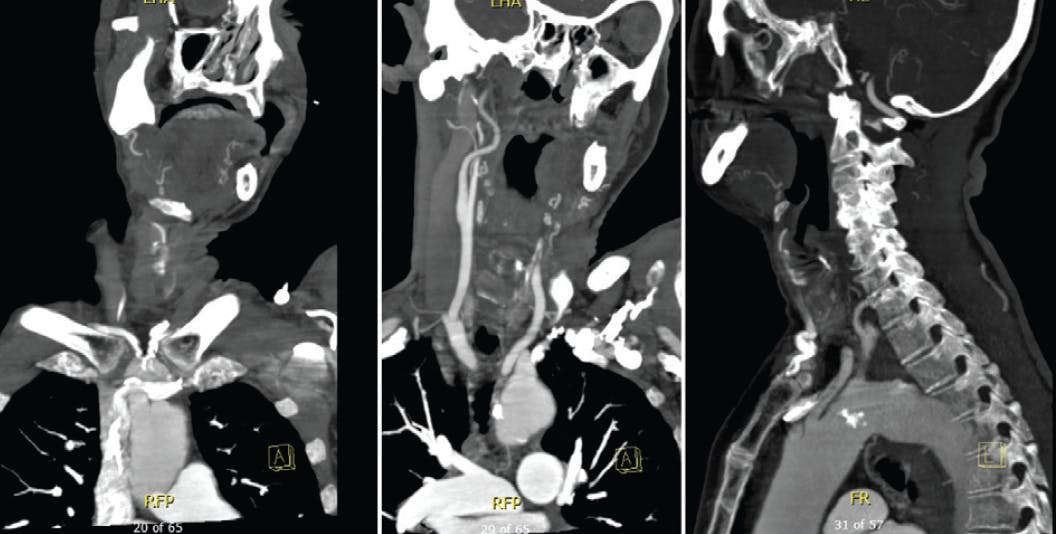
Figure 3. CTA coronal and sagittal MIPs showing a type III aortic arch.
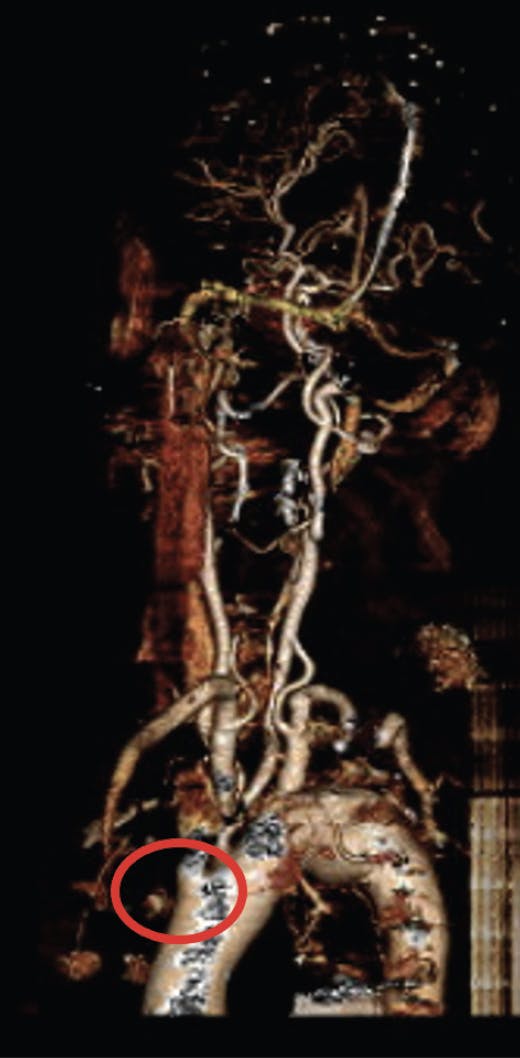
Figure 4. Type III aortic arch.
Do the results of imaging show anything of concern related to treatment? In your practice, how would you approach this case? For access, is the groin the first-line access strategy for anterior circulation strokes in your practice? Would you go through the groin or choose an alternative access in this case?
Dr. Hussain: This is an interesting case. Based on the information provided, it seems that this patient is a candidate for interventional stroke therapy, with no large infarction and good collaterals seen but a significant clinical deficit suggesting a large area of penumbra. As with many of our stroke patients, severe tortuosity of the arch and other vessels can provide a great challenge during treatment. Although we still utilize femoral access for many stroke interventional cases, we have increasingly found that the radial approach can be beneficial, particularly when arch anatomy is not favorable. It can be particularly well suited for the right carotid artery, as one does not have to traverse the aortic arch. We would do a quick ultrasound of the radial artery when the patient enters the angiography suite, and if > 2.3 mm, we consider radial as our first access (while still prepping the femoral artery as an alternative).
Dr. Kan: The access to the right ICA appears very difficult. Together with a large clot burden from an ICA-T occlusion, we know this will be a challenging case from the beginning. I would attempt femoral access first in my practice.
Dr. de Macedo Rodrigues: On noncontrast head CT, a hyperdense right MCA sign is seen and the slice provided shows no large acute territorial infarct or hemorrhage. CTA shows a right ICA-T occlusion with good collaterals, suggesting this patient is a good candidate for mechanical thrombectomy. The CTA images including the neck, however, show a type III aortic arch, which can be challenging to access. Nonetheless, I would still keep groin access as my first choice given that most of the time, including in type III arches, it is the fastest route to the target lesion with no constraints with regard to catheter size. Moreover, type III arches can also pose a challenge to radial access.
CASE CONTINUED
We took a femoral artery approach using an 8-F long sheath. We were unable to get an 8-F Walrus BGC (Q’Apel Medical Inc.) up and over the 6-F Berenstein, 5-F VTK, and 5-F SIM2 and over the Glidewire Advantage (Terumo Interventional Systems) due to an acute takeoff of the right innominate artery (Figure 5 and Figure 6). Our attempts with a 6-F Benchmark intracranial access catheter (Penumbra, Inc.) had the same results—herniating into the arch when trying to advance.
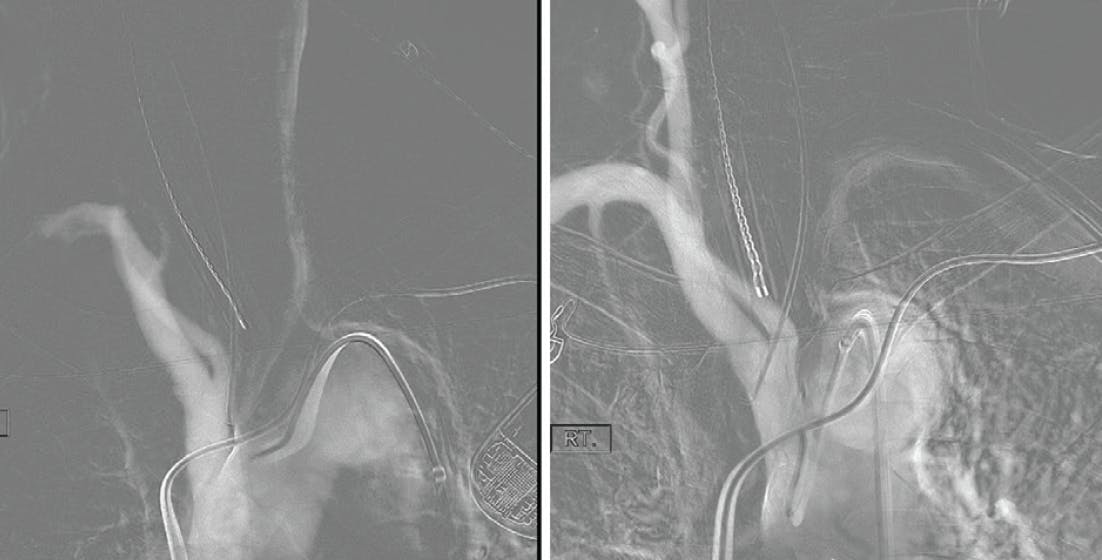
Figure 5. Arch roadmap images showing low takeoff of the innominate artery.
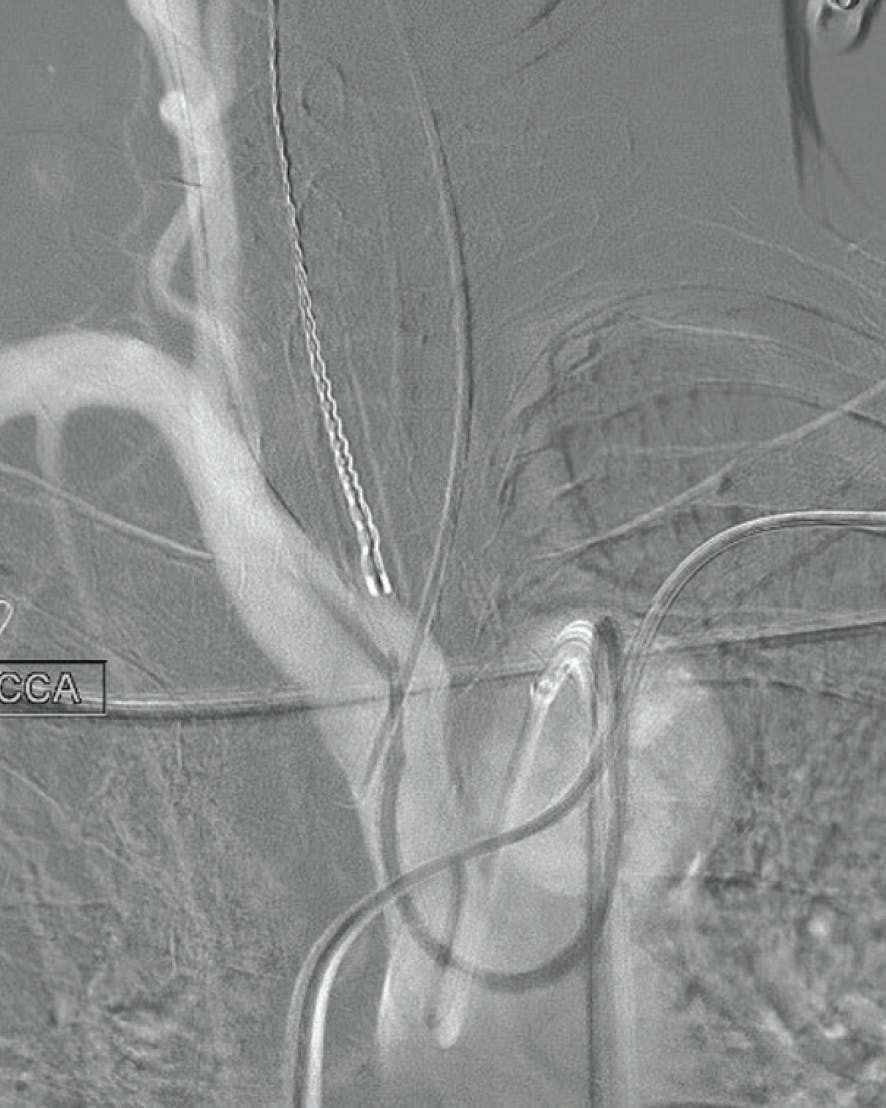
Figure 6. Patulous ascending aorta with type III aortic arch.
What would you do next? Would you have a different setup? How long would you try this access, and if you change access, what would your approach be?
Dr. Kan: I would have the same setup, trying to bring an 8-F system through a VTK, SIM Select catheter (Penumbra, Inc.). I would then switch to radial access. It appears a bit easier from radial to gain access to the right common carotid artery (CCA).
Dr. Hussain: It’s definitely a very challenging aortic arch. Coming from the femoral approach, we would try to take up our long sheath, but sometimes it is easier to get a standard 5-F diagnostic catheter into the carotid artery, get a good, stiff exchange wire in place, and then exchange it out for the long sheath. If unsuccessful, it would be reasonable to attempt a radial approach next, although this angle may also be challenging.
Dr. de Macedo Rodrigues: I would have started with a similar setup, a balloon guide catheter over a VTK or Simmons 2 access catheter. If this fails, I would remove the balloon guide catheter and try to gain access with 5-F SIM2 or VTK alone with the intent to establish a good wire access and then exchange this catheter over the wire for the balloon guide catheter. Given the extreme type III, capacious arch seen on the angiogram there's a high likelihood that this second attempt will fail; this would only be tried while the technician is setting up for radial access, which would be my next approach.
CASE CONTINUED
We continued our attempt through the radial access with the 6-F Benchmark catheter; however, it barely made it to the distal CCA, herniating into the arch on the attempts to further advance it (Figure 7 and Figure 8). We were able to get the catheter to the distal CCA.
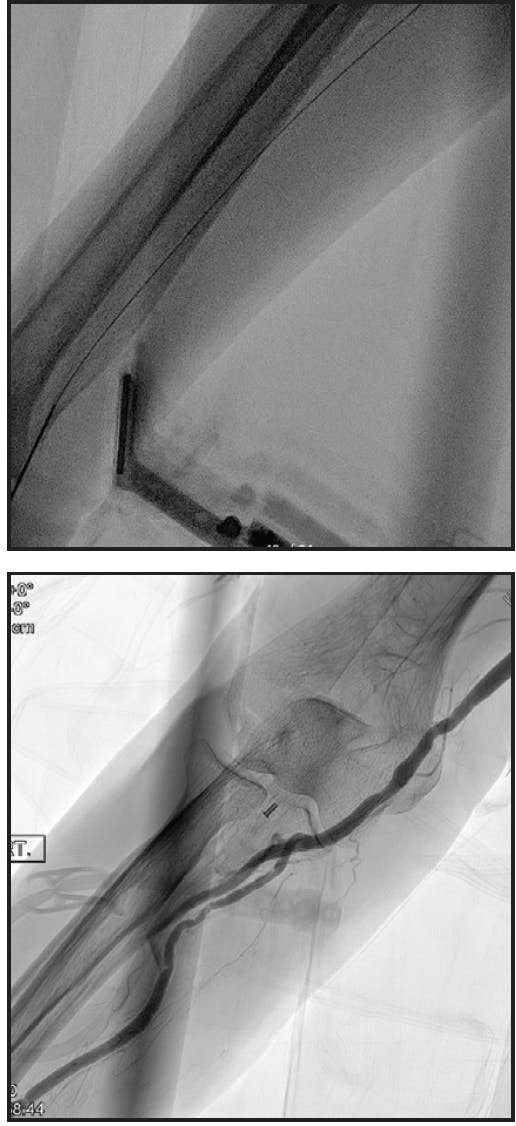
Figure 7. Ultrasound-guided access of the radial artery access and angiogram.
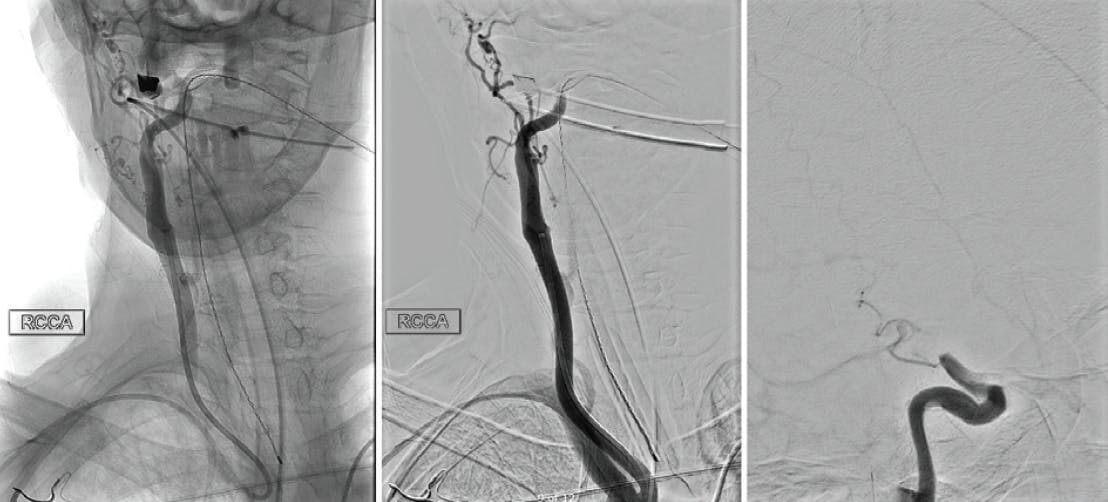
Figure 8. Right carotid angiogram via radial access showing a right ICA-T occlusion.
How would you approach this patient at this point?
• 5-F Sofia catheter (MicroVention Terumo) (aspiration or as intermediate catheter)
• Stent retriever thrombectomy with the Benchmark system
• Another approach
Dr. de Macedo Rodrigues: Due to the inability of advancing the Benchmark catheter more distally and high chances of further herniating into the aortic arch while advancing an aspiration catheter, I would proceed with a microcatheter only with the intent to expedite first pass with a stent retriever and use the stent retriever as an anchor to advance the Benchmark into the right ICA.
Dr. Hussain: Unfortunately, with a 6-F guide catheter, the options become limited, and with a large thrombus burden of an ICA terminus clot, it could be very challenging. We would likely utilize a combined approach with a 5-F Sofia with a stent retriever to see if we could wedge the thrombus and remove it.
Dr. Kan: I would perform a solumbra technique through an intermediate catheter (ie, 5-F Sofia). For example, a combined approach with aspiration through the 5-F Sofia while retrieving the clot into the Sofia catheter with a stent retriever.
CASE CONTINUED
Because we were already in the CCA, we continued with the current setup, but the microcatheter barely made it past the clot. Using a 6- X 40-mm stent retriever, the clot was retrieved (Figure 9 and Figure 10), but the patient was still thrombolysis in cerebral infarction (TICI) 0 due to high clot burden.
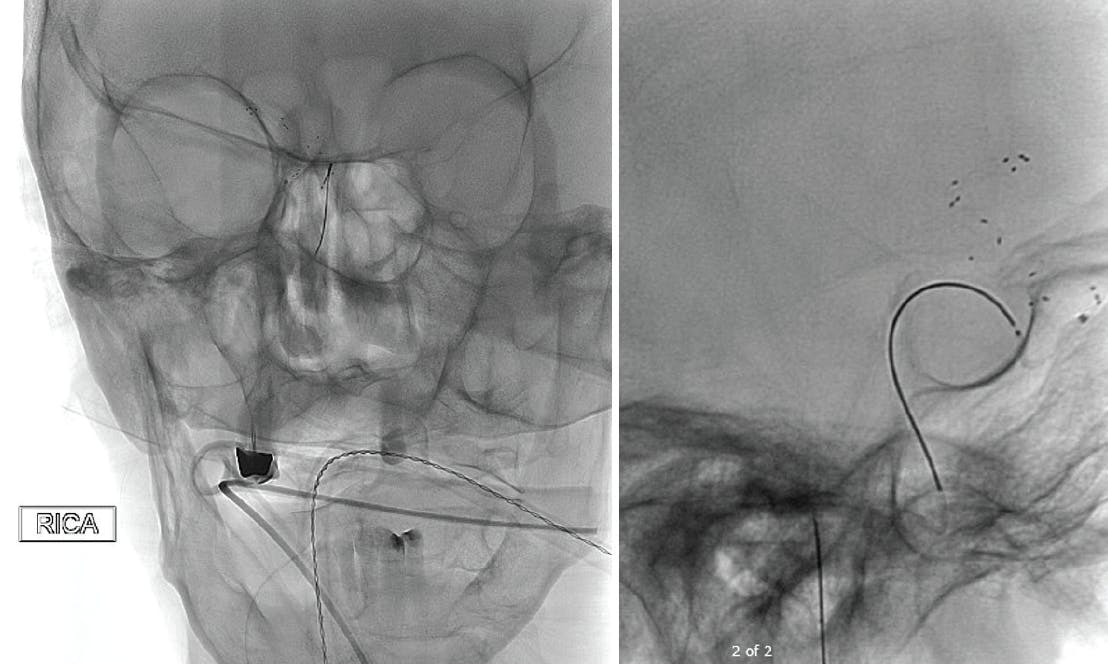
Figure 9. Stent retriever thrombectomy of the intracranial occlusion.
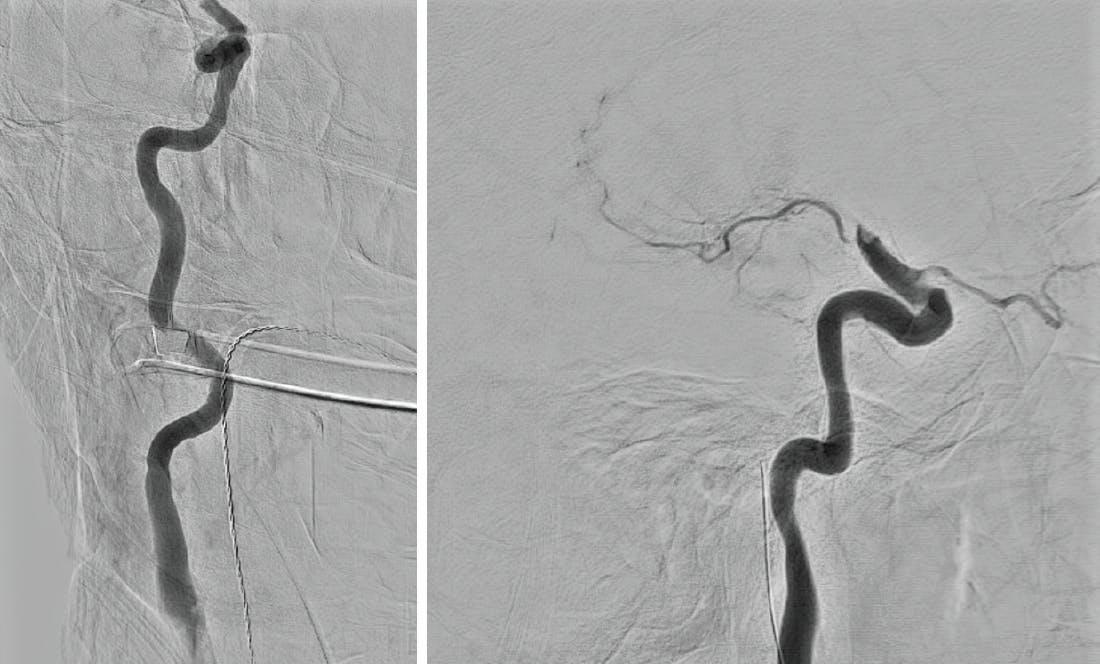
Figure 10. Post first pass TICI 0.
What is your next step in management?
• Attempt another pass with the same stent retriever system
• Attempt another pass using a different stent retriever
• Another approach
Dr. Hussain: As suspected, a large thrombus burden would make it difficult to open with the present setup. If a decent amount of thrombus was retrieved, another one or two attempts could be entertained. If occlusion remained, we would need to consider a different approach. In this case, presuming she is not too long after symptom onset and we still feel a good amount of penumbra is present, we would consider intubating the patient and performing a direct carotid puncture.
Dr. de Macedo Rodrigues: I would perform a second attempt with the same setup if I was able to further navigate the Benchmark catheter distally while performing the first pass. In this case, the likelihood that I would be able to navigate the microcatheter distal to the clot and have a successful second pass would have increased. However, if the result was no change or a more unfavorable catheter position, direct carotid puncture should be considered.
Dr. Kan: I would try another two passes with the stent retriever before going to carotid access. I would try three passes with the solumbra technique previously described, and aspiration alone with the 5-F Sofia catheter, which is even less likely to work because of its small caliber.
CASE CONTINUED
We decided to perform direct carotid puncture with a 6-F short sheath using the roadmap from radial access and ultrasound guidance (Figure 11 and Figure 12). We used a 6-F Sofia catheter directly through the sheath into the supraclinoid ICA, followed by stent retriever aspiration and mechanical thrombectomy (Figure 13 and Figure 14). The 1-year follow-up noncontrast CT is shown in Figure 15.
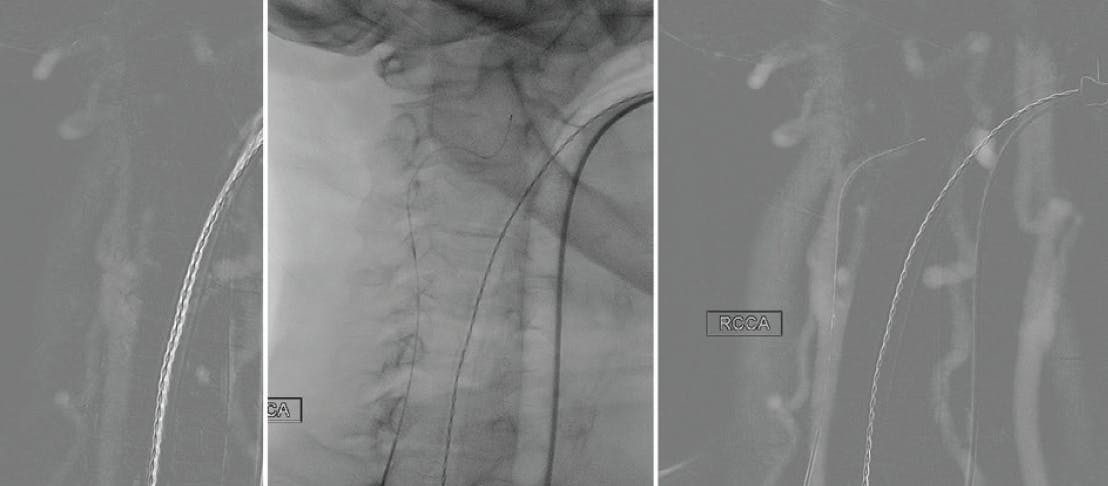
Figure 11. Ultrasound and roadmap-guided direct carotid puncture.
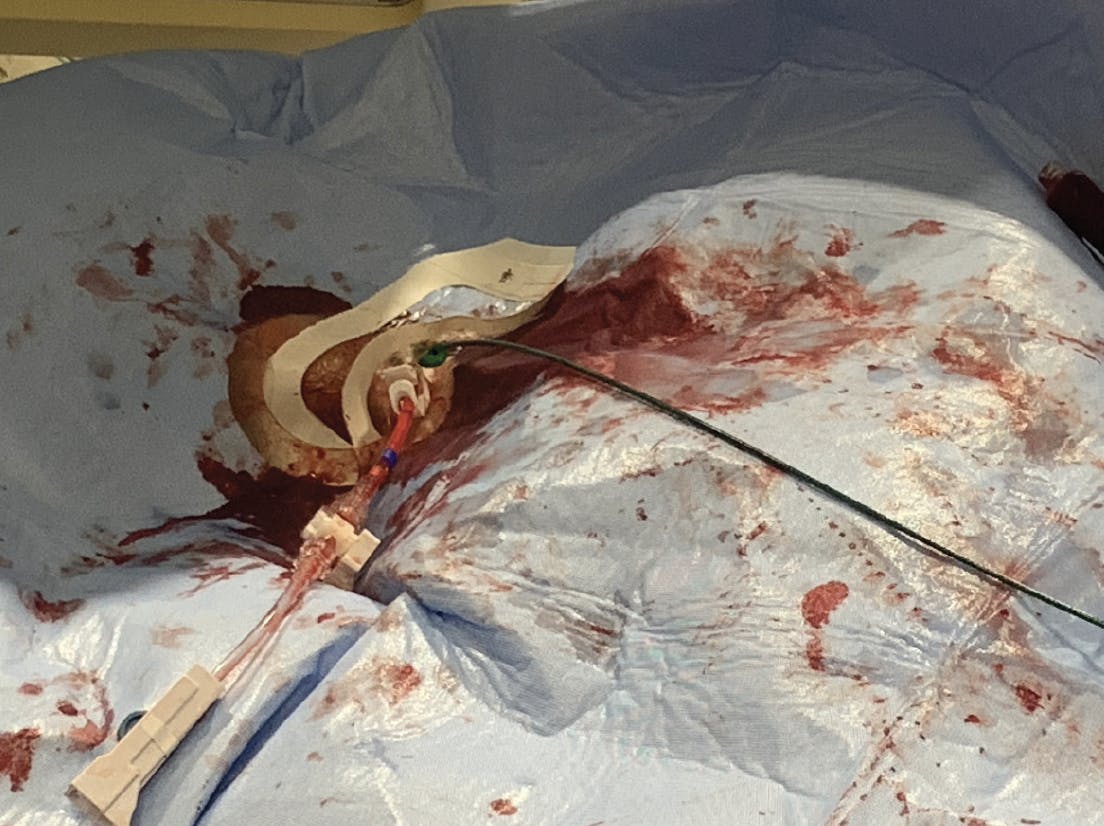
Figure 12. Direct carotid puncture.
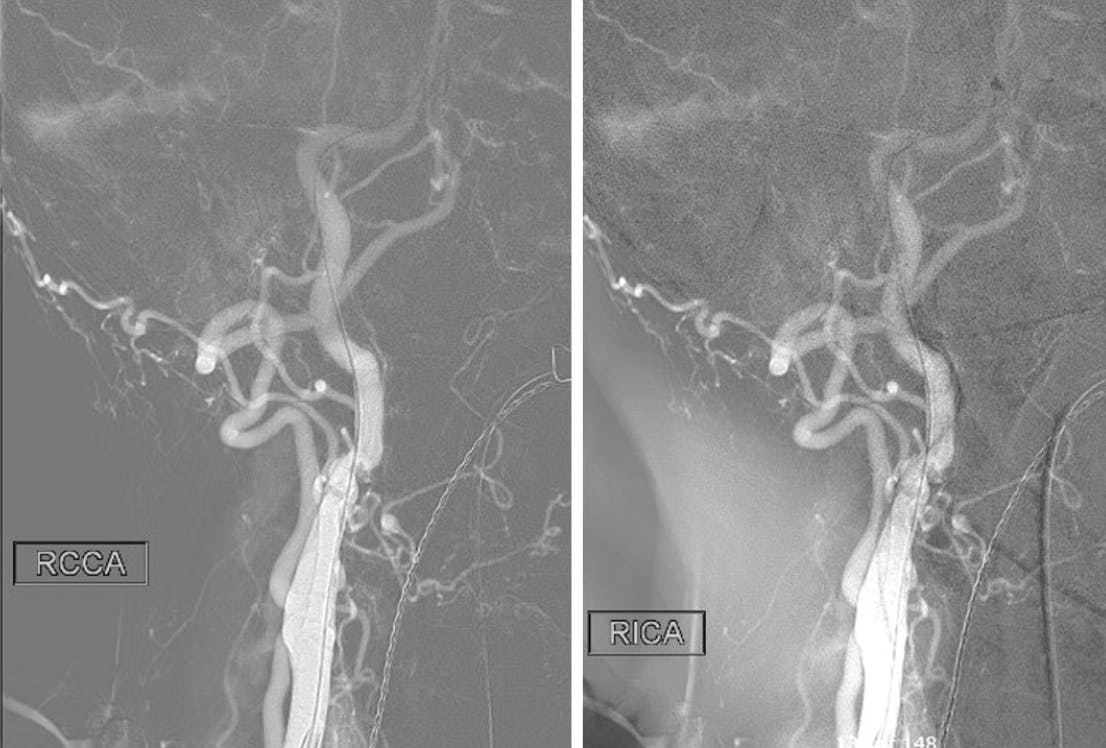
Figure 13. Combination aspiration stent retriever thrombectomy via direct carotid access.
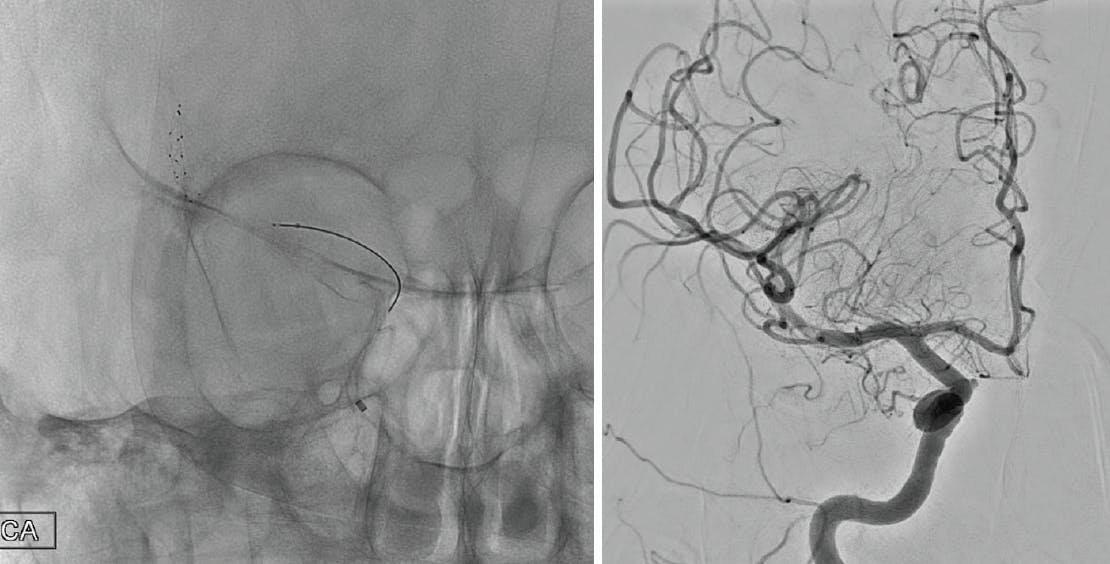
Figure 14. Postthrombectomy recanalization.
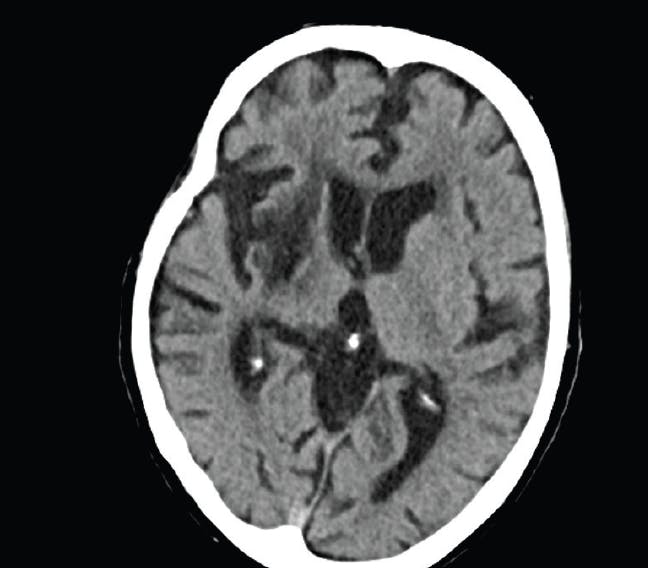
Figure 15. One-year follow-up head CT showing a small stroke burden.
How long do you attempt access from each access point (femoral, radial, others)? Is it time based, based on tissue at risk, or a combination of factors?
Dr. Kan: I would switch after I failed the standard setup quickly (based on time). I do not allow more than 20 minutes for access. Usually, within 20 minutes I would have tried my first and second line setup for access.
Dr. Macedo Rodrigues: I do not have a prespecified time limit for trying a specific access. Most of the time, it is a multifactorial decision. If there is some progression and I believe a different tip-shaped catheter or different wire will overcome the difficulty, I will most likely insist on my access. However, in case of very unfavorable anatomy with little to no progression, I would try a different access after very few attempts.
Dr. Hussain: To be honest, we would likely persist with the access we first achieve for longer than we should. There is usually a feeling that we may get it on the next try or with the next catheter. Given that stroke is very time sensitive and we have multiple safe and effective ways to access, we should be considering these routes sooner. I think it would be fair to consider switching if three maneuvers/20 minutes in the current approach have been attempted unsuccessfully.
This patient had not received tissue plasminogen activator. Would you have done direct carotid artery puncture if she had received lytics?
Dr. de Macedo Rodrigues: Given the high morbidity and mortality of an untreated ICA occlusion, I would still have performed a direct carotid puncture to attempt recanalization.
Dr. Kan: Yes, given the mortality and morbidity of ICA occlusion. I would try to close with Angio-Seal (Terumo Interventional Systems).
Dr. Hussain: I think it would give us more pause as we think through the options. However, because we intubate all of these patients if they need direct carotid access to ensure the airway will remain stable and use ultrasound guidance, I think this can be done safely on thrombolytics. Great care would need to be taken on closure and we would likely leave the patient intubated.
What is your approach to closure? Would you leave the patient intubated or extubate if lytics were administered for airway protection?
Dr. Kan: I would use Angio-Seal and leave the patient intubated overnight to ensure there is no hematoma development, especially if lytics were used and if I have to hold manual pressure for closure.
Dr. Hussain: Typically, we leave the patient intubated if direct carotid access is achieved (with thrombolysis or without), as we want to be sure there will be no hematoma related to the access site. Usually, the patient can be extubated the following day. One needs to be careful with closure, especially with risk of dissection related to closure devices, although holding direct pressure can also be concerning. StarClose (Abbott) or Angio-Seal are two that many use when talking to people around the country.
Dr. de Macedo Rodrigues: I would close my direct carotid puncture with a Perclose ProStyle closure device (Abbott) and examine with ultrasound for complication. Delayed extubation may be considered in case thrombolytics are on board, especially in the setting of difficult airway.
Advertisement
Advertisement