Advertisement
Advertisement
August 2022
Exploring the Why: Pivotal Case-Based Decisions
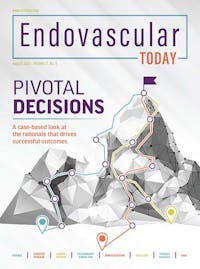
This edition of Endovascular Today focuses on case-based decision-making—the pivotal calls that can lead to a great outcome or a grueling day in your lead, and everything in between. The beauty (and sometimes beast) of our specialties is that no two cases are the same. Each clinical presentation is like a four-dimensional fingerprint, unique not only to the patient’s disease and severity on presentation but to the moment in time—their history and comorbidities, their preferences and lifestyle needs, and sometimes a gut-wrenching reappraisal of our own experience levels and capabilities.
In selecting the moderators, cases, and panelists for this edition, we’ve attempted to recreate the decisions made in everyday vascular practices, focusing on diverse viewpoints on the many nuances that can influence outcomes. Each participant candidly explains not just what they’d do at critical points throughout the case but the rationale behind their decisions, the pitfalls they aim to avoid, and, at times, the real-world limitations they must work around in their practices.
The format also highlights how confident humility can be a driver of success, the value of understanding what we don’t know, and exploring possibilities with our colleagues—and certainly our patients—before landing on a decision. The material covered spans a wide array of vascular services, with the hope being that vicarious lessons can be gleaned from cases similar to those we perform nearly every day and also those outside of our own practice boundaries.
To begin our feature, moderator Ajit S. Puri, MD, and panelists Muhammad Shazam Hussain, MD; Peter T. Kan, MD; and Katyucia de Macedo Rodrigues, MD, review a stroke case involving mechanical thrombectomy of an internal carotid artery–T occlusion. Then, moderators Michael C. Siah, MD, and Khalil Chamseddin, MD, and panelists Young Erben, MD; Manish Mehta, MD; Mehdi J. Teymouri, MD; and Kyle Reynolds, MD, tackle the case of a symptomatic patient with complex carotid disease.
Next, we have two aortic repair cases. First, Rana Afifi, MD, gathers Javairiah Fatima, MD; Aleem K. Mirza, MD; and Eanas S. Yassa, MD, to consider questions related to imaging modality, management, and treatment for a patient with type B aortic dissection and delayed mesenteric ischemia. Then, Sammy Siada, DO, leads Ravi N. Ambani, MD; Jeniann A. Yi, MD; and Sara L. Zettervall, MD, in a discussion about off-label repair for a case involving a symptomatic extent I thoracoabdominal aortic aneurysm with stranding around the aorta and bilateral pleural effusions.
Later, Michael McDaniel, MD, and Frances Mae West, MD, answer questions about a case from Geoffrey D. Barnes, MD, of a patient with acute pulmonary embolism in the upper and mid lobar arteries. For our embolization case, Kimberly Malka, MD, walks Clayton J. Brinster, MD; Bill Parkhurst, MD; and Jessica P. Simons, MD, through the case of a patient who underwent transcaval coil embolization for a type II endoleak from paired lumbar arteries.
Moving into the dialysis realm, Ulka Sachdev, MD, oversees a discussion with Yana Etkin, MD; Mark L. Lessne, MD; and Theodore H. Yuo, MD, about a young end-stage renal disease patient on hemodialysis with central venous occlusion of the upper and lower extremities.
For our venous disease cases, Karem Harth, MD, directs Avianne Bunnell, MD; Omar Chohan, DO; and Sara M. Edeiken, MD, in a conversation about a patient with a permanent inferior vena cava (IVC) filter who had extensive deep vein thrombosis of the IVC and iliac vein, and Eri Fukaya, MD, poses questions to Arjun Jayaraj, MD; Kathleen Ozsvath, MD; and Daniel L. Monahan, MD, about treatment for a patient with extensive venous reflux and asymptomatic varicose veins.
Closing out our cases, Meryl Simon Logan, MD, takes on the topic of peripheral artery disease management utilizing a radial access approach with Sarah J. Carlson, MD; Sabeen Dhand, MD; and Dejah R. Judelson, MD.
Also featured in this issue is a conversation with Nadine Abi-Jaoudeh, MD, about her endeavors in the hepatocellular carcinoma trial landscape, research consensus panels with the Society of Interventional Radiology Foundation, tips for fostering diversity, equity, and inclusion as an institutional leader, and more.
In our contemporary vascular and endovascular era, it is more important than ever for us to realize that our toolboxes are never quite full enough. I hope that this issue has provided you with a spectrum of challenging cases and unique approaches, which offer innovative techniques to add to your armamentarium. I want to thank all of the talented moderators and panelists for sharing their expertise, challenges, and experiences in hopes to expand our readers’ toolboxes as we all continually strive to improve patient outcomes in an ever-challenging specialty.
Guest Chief Medical Editor
Leigh Ann O’Banion, MD
Advertisement
Advertisement